

NASA's Perseverance rover captured images of a possible interstellar comet on the surface of Mars in early October. As reported by the Crusoe portal, the images were recorded on October 4 when the comet 3I/ATLAS He made his closest approach to the red planet.

Third interstellar object already documented
Comet 3I/ATLAS represents a historical discovery as it is only the third interstellar object documented in the Solar System. According to information released by the ICL News, this cosmic object is much larger than originally thought – reaching the size of Manhattan in New York.
Discovered in July 2025, the comet travels at an impressive speed of approximately 58 km/s. Its interstellar origin makes it a unique opportunity for scientists to understand more about objects coming from outside our solar system.
Amazing characteristics of the comet
According to Harvard University Astrophysicist Avi Loeb, the mass of the 3I/ATLAS must be more than 33 billion tons. The researchers reached this number by calculating the trajectory of the object and analyzing its gravitational acceleration.
The diameter of the comet's solid core is greater than 5 kilometers, surpassing the initial projections based on Hubble Space Telescope observations. This makes it significantly larger and more massive than its interstellar predecessors, Oumuamua (2017) and 2I/Borisov (2019).
Controversial theories about alien technology
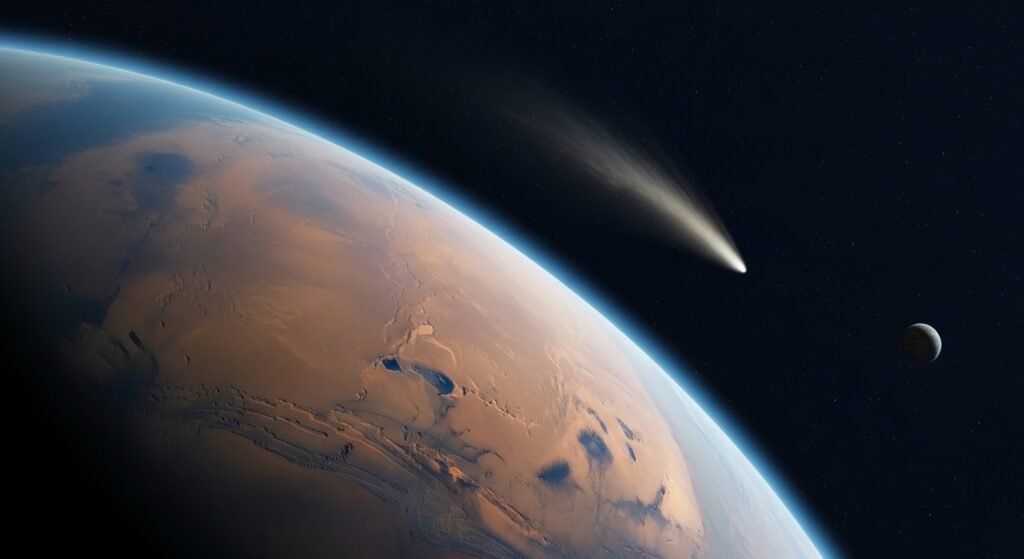
As reported by the New York Post, Loeb and his team raised a controversial hypothesis: the 3I/ATLAS could be an alien probe sent to carry out reconnaissance on Earth.
Scientists base this theory on several evidences:
- Anomalous non-gravitational acceleration
- Unusual approach to Venus, Mars and Jupiter
- Low retrograde inclination (turns in the opposite direction of the other bodies of the system)
- Trajectory that would allow access to Solar System planets
Scientific Community Shares Opinions
Other studies contest Loeb's theory. Researcher AKM Eahsanul Haque of the SETI Institute states that 3I/ATLAS is a natural body, probably a fragment of an ancient planet, not a spacecraft.
The characteristics of the object, according to Haque, are fully explained by natural processes known to science.
International collaboration in observations
The European Space Agency (ESA) is actively involved in comet observations. Ships like ExoMars Trace Gas Orbiter and Mars Express have monitored the object, providing important data for the analysis.
According to the Crusoe portal, two probes orbiting Mars recently recorded the "closest view" ever obtained from the 3I/ATLAS by ESA.
Challenges in Confirmation
Despite the captured images, NASA has not officially confirmed that Perseverance has registered comet 3I/ATLAS. The U.S. government shut down delayed agency communications, compromising immediate disclosures.
The images show a possible luminous trail, typical of comets, but detailed analyses are necessary to prove their identity definitively.
Next steps and Earth's safety
Researchers from various space agencies work to obtain more data on 3I/ATLAS. NASA's Mars Reconnaissance Orbiter is also analyzing the event, and new data should be released soon.
As for security, scientists ensure that ATLAS poses no threat to Earth. Its trajectory will take you to reach 2.78 million kilometers from Mars' orbit around the Sun.
crucial observation window
The scientific community looks forward to the maximum approach of the comet to the Sun in the coming months. This window is considered essential for more detailed observations, which may reveal crucial information about its composition and trajectory.
This event represents an unprecedented opportunity to better understand the interstellar visitors of our Solar System, regardless of its natural or artificial origin.