Harvard astronomers hypothesize that 3I-Atlas is not a common comet, but possible hostile alien technology.
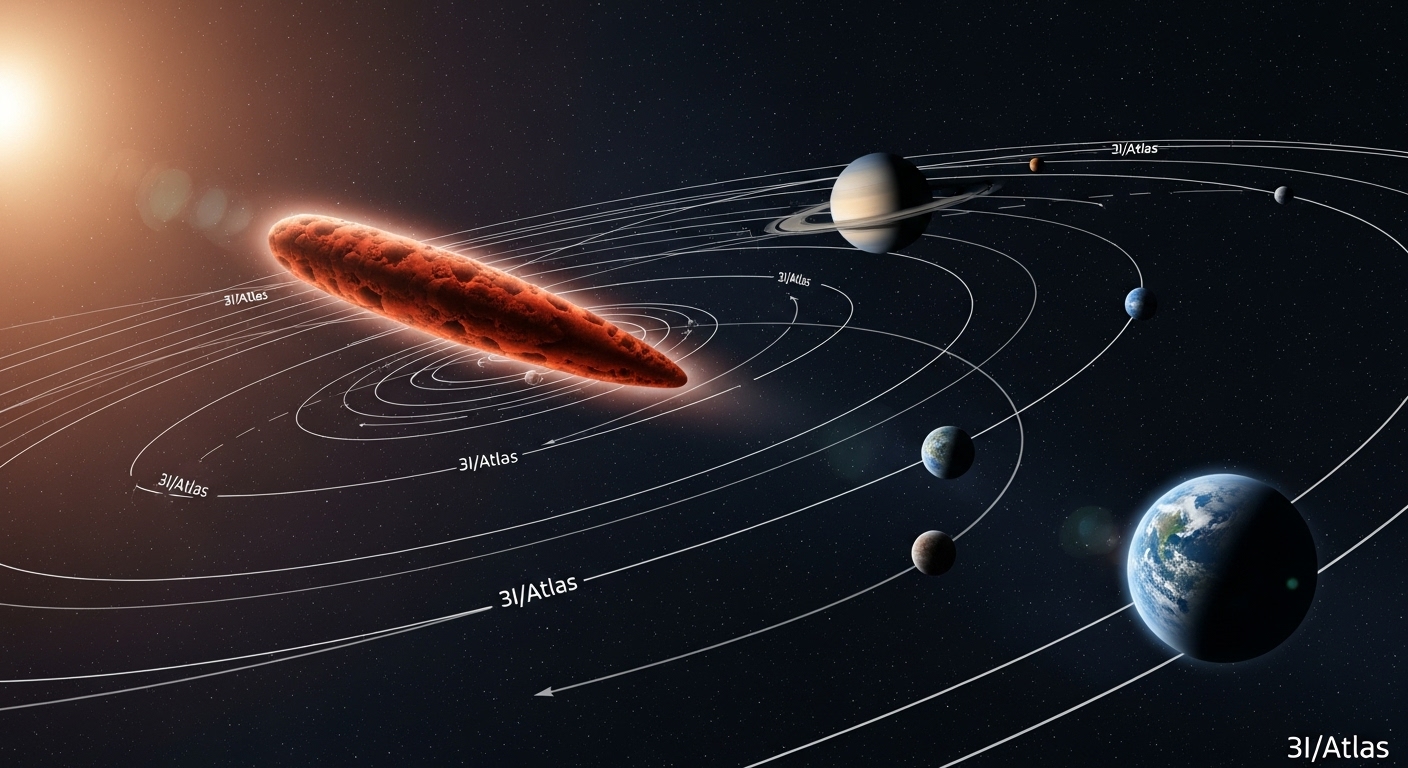
A recent discovery is messing with the world's scientific community. The interstellar object 3I-Atlas, detected in July by the ATLAS telescope in Chile, has characteristics so peculiar that Harvard astrophysicians began to question its natural origin.
Avi Loeb, renowned Harvard astrophysicist, co-signed a controversial study suggesting that the object may be alien technology. The research published yesterday raises a possibility that few scientists dare to discuss: would we be in front of an extraterrestrial ship?
What makes 3I-Atlas so suspicious?
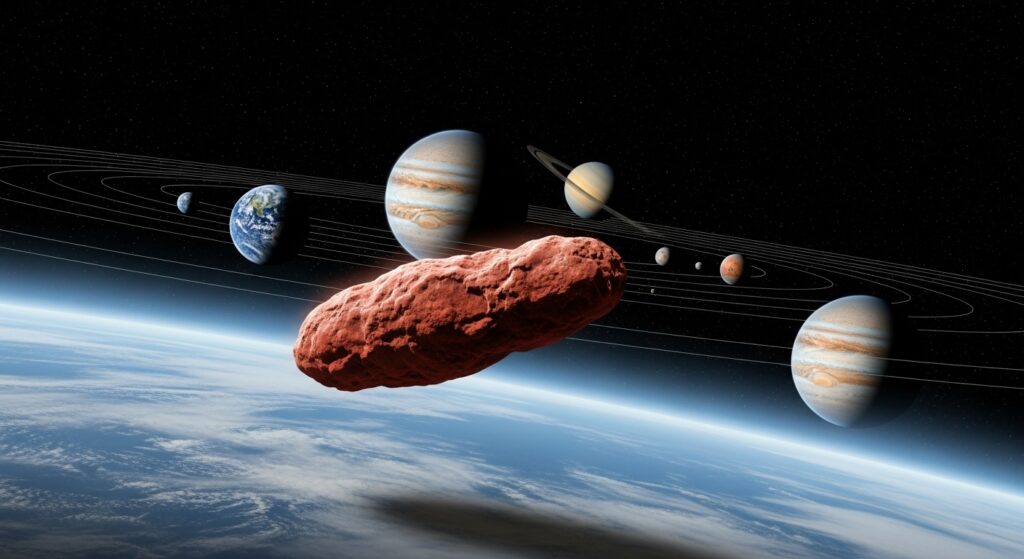
The object doesn't behave as it should. First, its retrograde orbit is aligned with the plane of Earth – a coincidence of only 0.2% probability. It's like hitting the lottery without buying a ticket.
Second point: 3I-Atlas is about 20 kilometers in diameter, too large for a asteroid common interstellar. We should have detected millions of smaller objects before we found anything this size.
And it doesn't stop there. Spectroscopic analyses show no typical signs of cometary gases. What we see is a reddish object, without the characteristic "tail" we would expect from a comet.
Why does it matter now?
The trajectory of 3I-Atlas is almost perfect for a reconnaissance mission. The object will dangerously approach Venus (0.65 AU), Mars (0.19 AU) and Jupiter (0.36 AU). The cumulative probability of this triple approach is only 0.005%.
More intriguing: 3I-Atlas will reach the perihelion (closest point to the Sun) exactly on the opposite side of the Earth. An ideal position to avoid detailed observations or, in a darker hypothesis, to launch "devices" undetected.
What do the experts say?
Loeb and his collaborators at the London Interstellar Studies Initiative do not categorically state that 3I-Atlas is an alien. But they apply the logic of the Pascal Bet: better to consider the possibility and prepare yourself than to ignore an existential risk to humanity.
The hypothesis is based on the theory of the Dark Forest, popularized by the Chinese writer Liu Cixin. According to this idea, advanced civilizations remain silent to avoid being detected by even more powerful cosmic predators.
"Let's see what the next observations will show," says a Brazilian astronomer who chose not to identify himself. "But it is impossible to ignore so many anomalies. "
What are the impacts on people?
If 3I-Atlas is really a probe alien, two scenarios are drawn. In the first, benevolent, we await an interstellar "messenger". The second, more worrying, we deal with a real threat.
The object entered the Solar System about 8,000 years ago, curiously when human technologies began to document history. Coincidence or not, it's an interesting timing.
The speed of 60 kilometers per second makes any interception with our current technologies impossible. If anything is launched from 3I-Atlas towards the planets, it would need only 5 km/s – speed reachable by intercontinental ballistic missiles.
Curiosity that intrigues scientists
3I-Atlas comes from the center of the Milky Way, a region with many stars that hindered its early detection. If it was discovered a year earlier, we could have launched a mission to intercept it.
The object will be visible until September, when it will pass very close to the Sun for observations. It will return in December 2025 – a period that coincides with a great window to intercept the Earth.
Now what?
Vera C. Rubin Observatory will detect dozens of interstellar objects in the next decade. Each will need to be analyzed with the same scientific rigor applied to 3I-Atlas.
Loeb argues that ignoring the possibility technological "is not a sign of intelligence". The scientific community is divided between healthy skepticism and genuine curiosity.
3I-Atlas continues his journey through Solar System, carrying secrets that can change our understanding of life in the universe. Or maybe it's just another peculiar comet in a galaxy full of mysteries.
And you believe we're alone in the universe? What do you think of this discovery?