Imagine a cosmic traveler who has travelled unimaginable distances across the galaxy, passing through unknown star systems and finally crossing our heavenly backyard.
This is not a science fiction plot – it is the real story of visitor comet interstellar 3I/ATLAS, one of the most fascinating objects ever observed by mankind.
In this complete article, we will explore every aspect of this interstellar visitor and understand why it represents a milestone in the history of astronomy.
What you will find in this article:
What Makes 3I/ATLAS So Special?
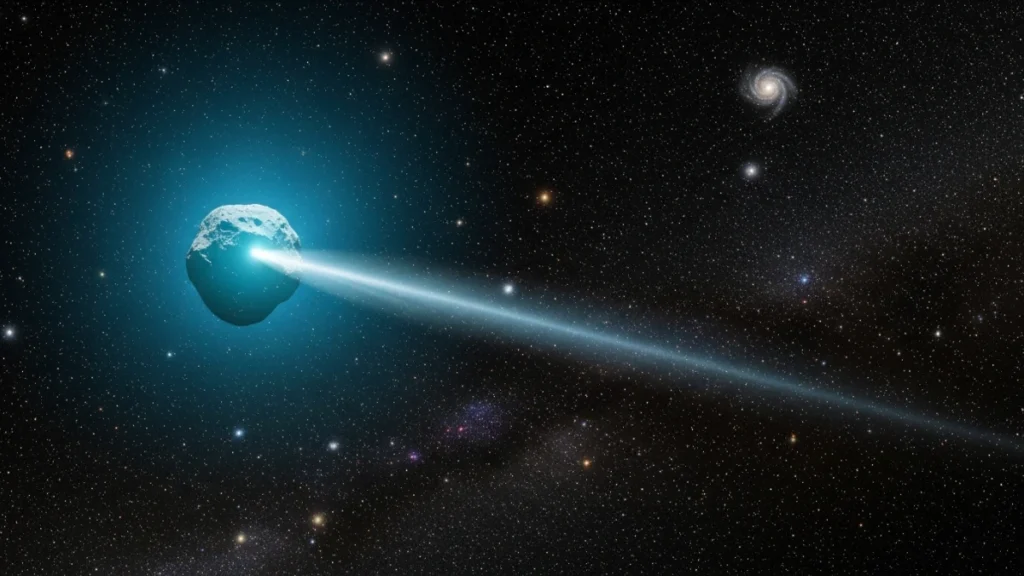
Discovered on December 28, 2019 by the Earth asteroid impact alert system (ATLAS) in Hawaii, the comet 3I/ATLAS carries a deep historical meaning. The "3I" in its name is not just an acronym – it represents a unique classification: it is only the third confirmed interstellar object in the history of astronomy, following the famous ‘Oumuamua in 2017 and comet Borisov in 2018.
Why Are Interstellar Visitors So Rare?
The detection of interstellar objects is extremely unusual for several fundamental reasons:
- Limited size and brightness: Most of these objects are small and difficult to detect
- Extremely high speed: They pass through the solar system quickly
- Unpredictable trajectories: Their orbits are hyperbolic, unlike the objects of our solar system.
- Short observation windows: We only have a few weeks or months to study them.
The Discovery That Changed Everything
The identification of the 3I/ATLAS was not a happy accident, but the result of years of investment in observation technology. The ATLAS system, composed of four telescopes in Hawaii, Chile, and South Africa, was specifically designed to detect objects that might pose a danger to the Earth. However, his ability to find interstellar visitors proved equally valuable.
How Astronomers Confirmed Their Interstellar Origin
Confirmation that the 3I/ATLAS came from outside our solar system involved complex calculations of its orbit:
- Analysis of orbital eccentricity: Solar system objects have elliptical orbits, while interstellar orbits have hyperbolic orbits
- Speed calculation: Its speed was too high to be gravitationally connected to the Sun
- Trajectory tracking: Accurate determination of its origin and destination
Physical Characteristics of Comet 3I/ATLAS
Unlike the ‘Oumuamua, which generated controversy over its nature, the 3I/ATLAS showed clear comet characteristics from the beginning:
Core and Coma
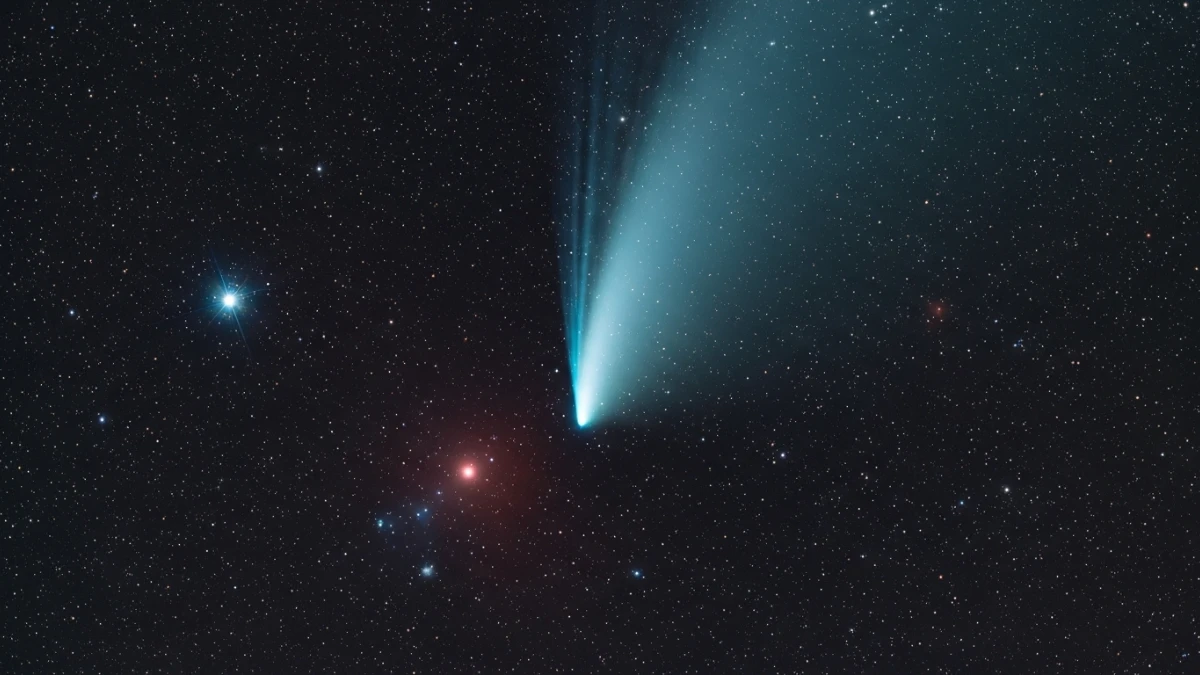
Initial observations suggested a nucleus between 100 meters and 1 kilometer in diameter. As he approached the Sun, he developed a coma – the cloud of gas and dust that characterizes comets – that reached tens of thousands of kilometers in length.
Revealing Chemical Composition
Spectroscopic analyses revealed family compositions, but with intriguing proportions:
- Water (H2O): Main component, as in most comets
- Carbon monoxide (CO): Present in significant quantities
- Cyanogen (CN): Detected in proportions that suggest different origins of solar comets
Trajectory and Unexpected Behavior
Comet 3I/ATLAS presented a behavior that surprised astronomers. Initially promising to become visible to the naked eye, he began to fragment as he approached the Sun, a common destination for fragile comets.
Why Was Fragmentation Significant?
The disintegration of the comet, although disappointing for amateur observers, provided valuable scientific data:
- It revealed the internal structure: Fragmentation exposed normally inaccessible internal layers
- Provided resistance information: Suggested a less cohesive structure that comets from the solar system
- Allowed composition studies: Analysis of different fragments revealed heterogeneity
Scientific and Astrobiological Implications
The study of 3I/ATLAS goes far beyond mere astronomical curiosity. It has profound implications for our understanding of the universe:
Interstellar Transport of Ingredients of Life
One of the most fascinating theories suggests that interstellar comets may be panspermia vectors – the hypothesis that the ingredients of life can be distributed throughout the galaxy through these cosmic messengers.
Comparison With Comets of the Solar System
The differences observed in 3I/ATLAS in relation to solar comets suggest that:
- Training processes can be universal: Basic similarities indicate that comet formation follows similar processes in different star systems
- Compositions vary: Chemical differences reflect different conditions in places of origin
- Diverging developments: Different histories lead to distinct structural characteristics
The Future of Interstellar Object Study
The discovery of the 3I/ATLAS accelerated plans for future interstellar visitor study missions:
Space Missions Proposals
Several space agencies are developing concepts to intercept future interstellar visitors:
- Lyra Project: Initiative for Interstellar Studies concept to achieve interstellar objects
- Opportunity missions: ESA and NASA plans to redirect existing probes
- New observatories: Telescopes like Vera C. Rubin will dramatically increase our chances of detection
Development Detection Technologies
New systems are being implemented to improve our ability to find these rare objects:
- Machine learning algorithms: To identify interstellar objects in large data sets
- Automated telescope networks: Covering the whole sky continually
- Quick alert systems: To allow detailed observations before objects drift away
How Amateur Observers Can Contribute
Although 3I/ATLAS is no longer visible, the amateur astronomy community plays a crucial role in the discovery and monitoring of future interstellar visitors:
Citizen Science Programs
Several initiatives allow enthusiasts to contribute significantly:
- Zooniverse: Platform with various astronomical data classification projects
- Backyard Worlds: NASA project to identify nearby objects
- Amateur observatories: Networks of observers which may provide additional data
Conclusion: A New It was space exploration.
Comet 3I/ATLAS represents much more than just another object in the sky. It symbolizes the beginning of a new era in astronomy – an era where we can directly study materials from other star systems. Each interstellar visitor as 3I/ATLAS provides us with a unique glimpse of the diversity of the cosmos and helps us understand our place in the universe.
As we improve our detection capabilities, we are likely to find that these interstellar travelers are more common than we thought. Each brings with it stories of distant star systems and potentially answers to some of humanity's greatest questions: Are we alone in the universe? How did life begin? What are the other planetary systems like?
The legacy of 3I/ATLAS will continue to inspire generations of scientists and space enthusiasts. His brief passage through our solar system left us with more questions than answers – and that is exactly what makes space exploration so fascinating.
Do you want to stay up to date on the latest astronomical discoveries? Follow us on our social networks and subscribe to our newsletter to receive first-hand information about the next interstellar visitors that we will certainly discover in the coming years.
source: science-nasa