By Writing TecNerds | 9 July 2025 | Science and Technology
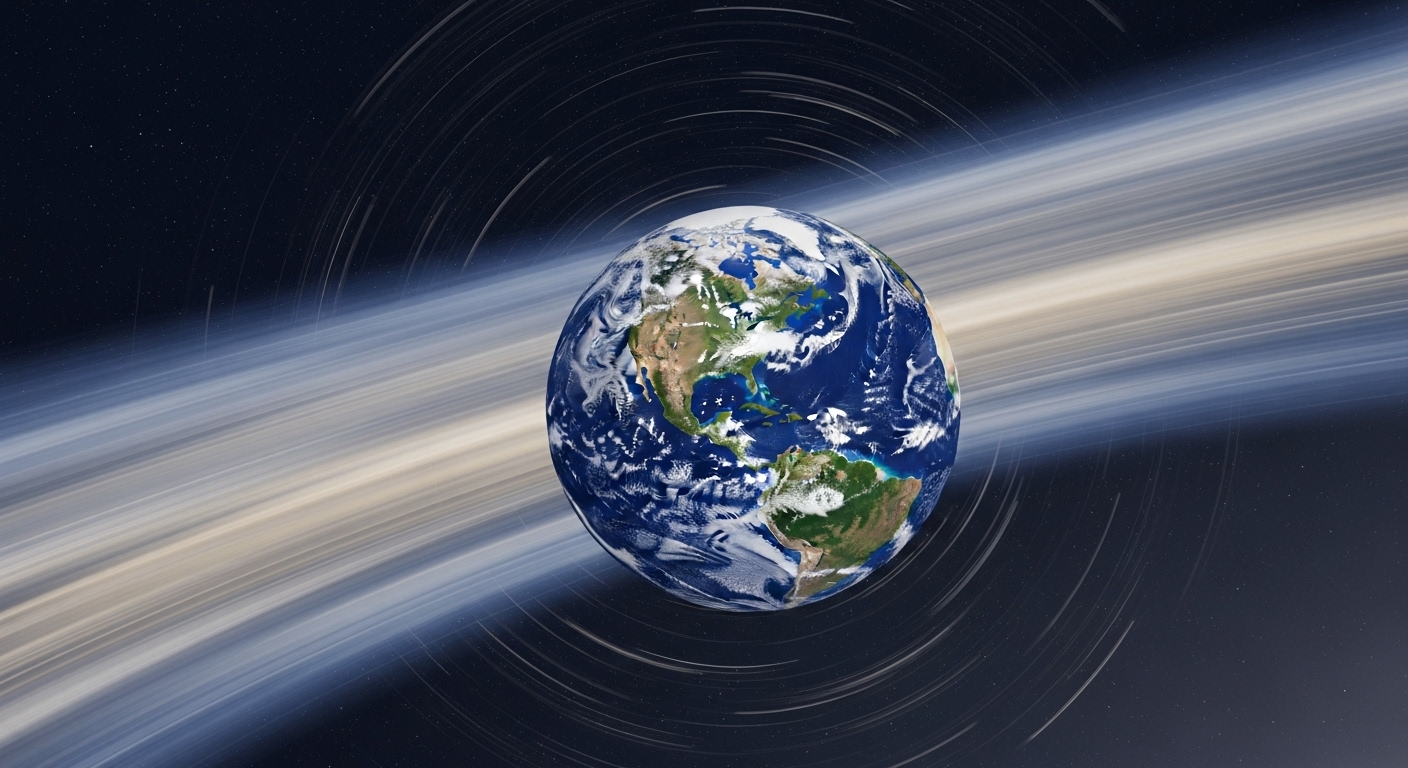
The Earth is literally spinning faster, and today, July 9, marks the first of three especially short days scheduled for 2025. According to data from the Time and Date platform, in partnership with the International Earth Reference and Rotation Systems Service (IERS), our planet will complete its rotation 1.30 milliseconds faster than usual.
This intriguing phenomenon represents a significant change in Earth's rotational behavior, which has been surprising scientists since 2020. In the last five years, 28 of the shortest days of History modern, countering decades of gradual deceleration caused by the gravitational influence of the Moon.
What's happening to our planet?

Historically, land rotation was slowing consistently. Billions of years ago, a day lasted only between three and six hours. The gravitational action of the Moon gradually stopped this rotation until we arrived at 24 hours today. However, since 2020, this pattern has changed dramatically.
Graham Jones, a specialist in planetary rotation, explains that "long-term variations in Earth's rotation speed are affected by a long list of factors, which include the complex movement of the nucleus, oceans and Earth's atmosphere". The researcher points out that this current acceleration is considered "unusual" by the scientific community.
Key dates for 2025
Besides today, scientists have identified two other critical dates: July 22nd and August 5th. These days can break historical records of rotational speed, representing the fastest moments ever recorded since the beginning of modern measurements in 1973.
Interestingly, these dates coincide with periods when the lunar orbit is at its furthest point of the Equator Line. O Earth movement in its own axis tends to be faster when our natural satellite is in this specific position.
" We are facing an unusual acceleration," say the scientists of the IERS, highlighting that the current models cannot fully explain this phenomenon.
Possible causes of the phenomenon
Although there is no definitive explanation, researchers raise several scientific hypotheses. Among the main theories are changes in the movements of the terrestrial nucleus, changes in oceanic and atmospheric currents, and melting glaciers causing redistribution of planetary mass.
Leonid Zotov of Moscow State University and specialist in land rotation, along with his colleagues Christian Bizaard and Nikolay Sidorenkov, point to a phenomenon called "Chandler's Oscillation" – an irregular movement of the Earth's geographic poles across the surface of the globe.
O global warming also emerges as a possible contributing factor. The accelerated melting of glaciers not only raises the level of the seas, but also redistributes mass throughout the planet, potentially affecting the rotational dynamics.
Technological and practical impacts
Although imperceptible in everyday life, this acceleration has significant implications for systems technology. GPS devices, communication networks and navigation systems depend on extreme temporal accuracy. Differences in milliseconds can cause errors in global positioning and synchronization calculations.
If the acceleration trend continues, scientists may need to implement a "negative intermediate second" – something never done before in history. Currently, positive intermediate seconds are occasionally added to atomic clocks to compensate for the Earth's natural deceleration.
Continuous monitoring
The IERS will continue to closely monitor Earth's rotation in the coming months, with regular updates on the planet's behavior. This monitoring is crucial to understand whether we are facing a temporary anomaly or a fundamental change in Earth's rotational behavior.
While the shorter days of 2025 serve as a reminder that our planet is a dynamic system, the scientific community works intensely to unravel the mysteries behind this unexpected acceleration. The answer can reveal fundamental aspects of the inner functioning of our planet and its interactions with cosmic forces.