By Raphael on 15 January 2026;
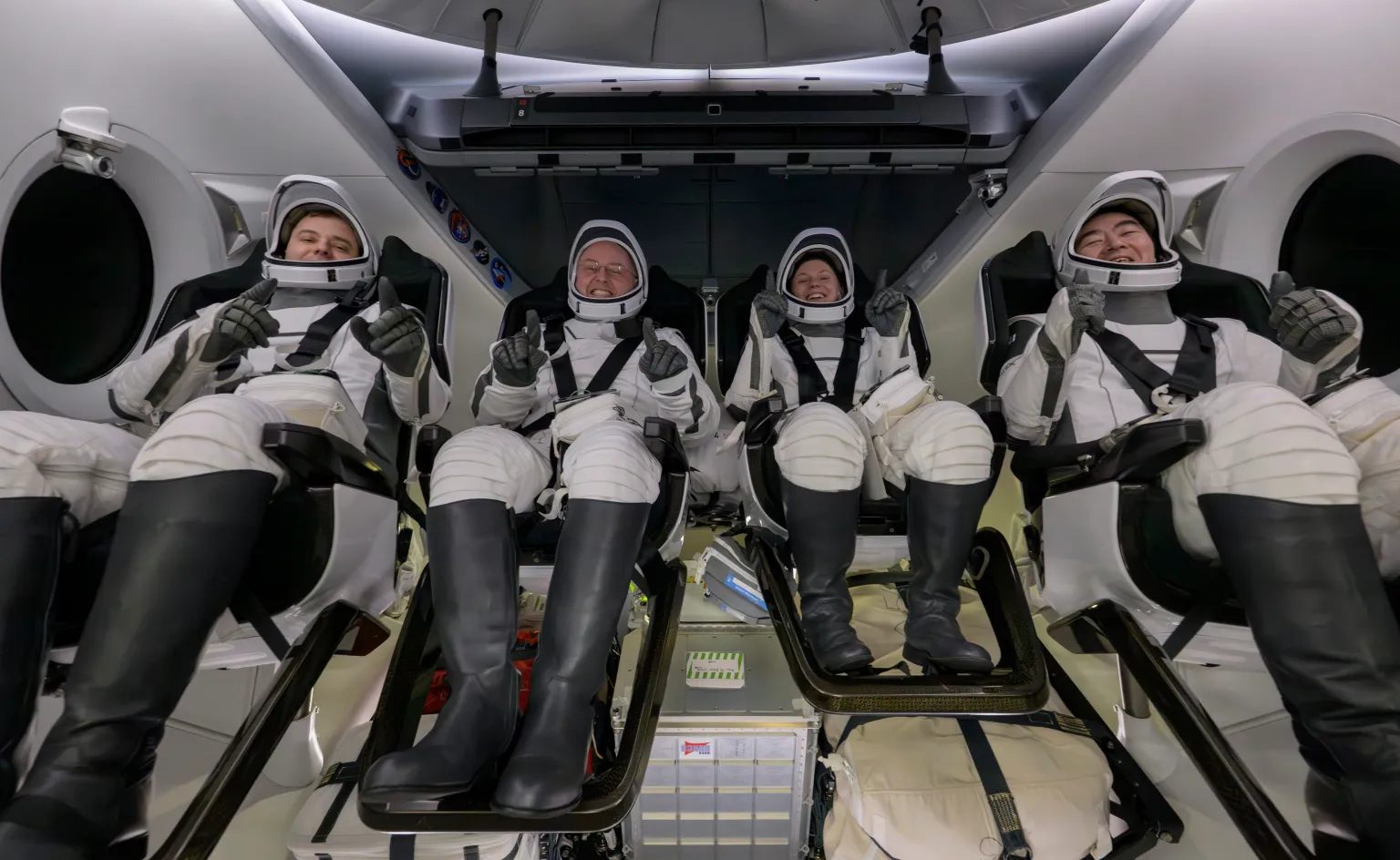
When the four SpaceX Crew-11 astronauts emerged from the Pacific waters early on Thursday, they not only completed one more space mission – they consolidated a landmark that redefines our relationship with space. After more than five months orbiting Earth on the International Space Station, the crew returned with a scientific baggage that promises to revolutionize various fields of human knowledge.
The Crew-11 mission, which represents the maturity of the partnership between NASA and SpaceX, demonstrates how commercial space exploration reached a level of reliability that few imagined possible a decade ago. But what really makes this special return goes far beyond the technical precision of landing – are the scientific advances made during those 168 days in the space.
The Technical Complexity Behind SpaceX Crew-11 Perfect Aterisage
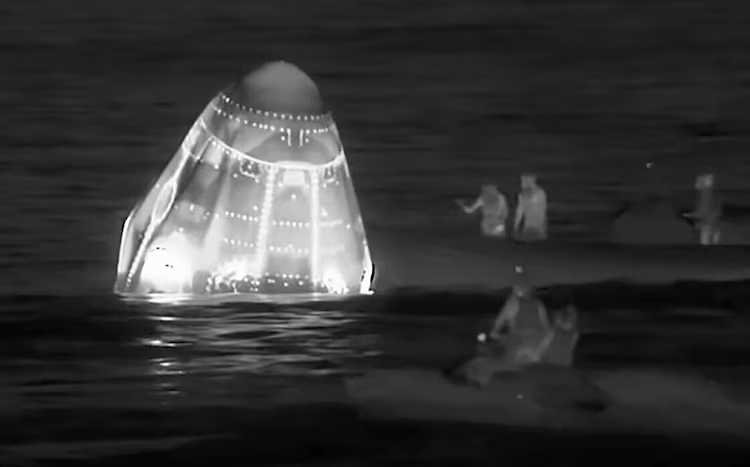
The landing of the Dragon capsule off the coast of San Diego was not just an impressive visual spectacle. As someone who has been accompanies space missions for more than 15 years, I can say that the accuracy demonstrated represents a qualitative leap from the first manned commercial missions.
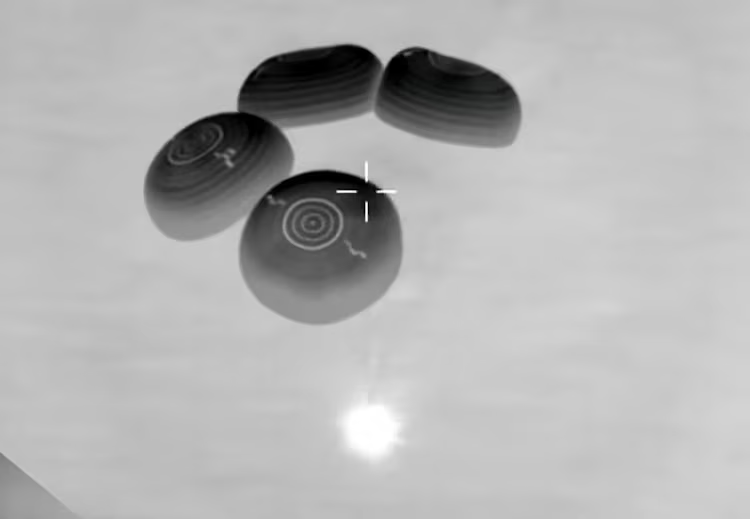
The sequence of events preceding a successful landing involves extremely complex calculations. The capsule needs to perform a series of deceleration maneuvers at exact moments, considering variables such as Earth rotation, atmospheric conditions and ocean currents. The fact that Crew-11 reached the landing zone with an error margin of less than two kilometers demonstrates the technological maturity achieved.
During the critical reentry period, the Dragon capsule faced temperatures above 1,900°C, protected by its state-of-the-art heat shield. The parachute redundant systems – four main and two stabilization systems – worked in perfect sync, reducing the speed from 28,000 km/h to approximately 24 km/h at the time of touch on the water.
Technical Innovations That Make a Difference
One of the features that makes SpaceX missions unique is the almost integral reuse capacity of the components. The Dragon capsule used in Crew-11 had already completed two previous missions, being carefully reconfigured and tested between flights. This practice not only reduces operating costs by approximately 30%, but also allows constant refinement of systems based on actual flight experience.
Data collected during this mission are already being analyzed for implementation of improvements in Crew-12, scheduled for March 2025. This continuous cycle of improvement represents a fundamental change in the philosophy of space exploration.
Scientific Discoveries That Transform Our Future
But the true value of the Crew-11 mission lies in experiments conducted during the 168-day ISS. The crew performed more than 230 scientific experiments, many with direct applications to improve the quality of life on Earth.
Among the most promising results is the development of new semiconductor materials in microgravity. In an environment without severity, it is possible to create crystals with structures impossible to obtain on Earth, potentially revolutionizing the electronic industry. The first tests indicate energy efficiency 40% higher than conventional materials.
Advances in Space Medicine
Medical research conducted by SpaceX Crew-11 brought fascinating insights into human adaptation to the space environment. Studies on bone density loss revealed that specific exercises developed in ISS can be applied to the treatment of osteoporosis in the elderly on Earth.
Particularly interesting was the experiment with microgravity stem cell culture. Cells showed 300% faster growth and more efficient differentiation, opening possibilities for treatment of degenerative diseases that seemed distant a few years ago.
The Economic Impact of Commercial Space Exploration
The SpaceX Crew-11 mission represents more than scientific advancement – it symbolizes the consolidation of a new economic model for space exploration. When NASA started the Manned Commercial Program in 2010, many questioned the feasibility of transferring critical responsibilities to private companies.
Today, the numbers speak for themselves: each commercial mission costs approximately 55% less than the Space Shuttle program, while offering superior scientific cargo capacity and greater operational flexibility. This model released NASA resources to invest in long-term exploration projects, such as Artemis missions to the Moon.
Pro tip: The economic success of commercial missions created a multiplier effect, stimulating private investments in space technology that reached US$ 8.9 billion in 2024.
Creating New Markets
The reliability demonstrated by missions like Crew-11 is catalyzing the development of previously nonexistent space markets. Pharmaceutical companies already hire space in the ISS for drug research, while universities compete for opportunities to perform microgravity experiments.
This emerging economic ecosystem projects growth of 15% per year, with the potential to generate more than 100,000 specialized jobs over the next five years, according to Space Foundation analyses.
Preparing the Way to Artemis and Beyond
Have you ever wondered how the lessons learned in Earth orbit will apply to future lunar missions? Crew-11 served as a living laboratory to test procedures and technologies that will be essential in the Artemis program.
During the mission, the astronauts tested new communication protocols with simulated delay, replicating conditions they will face on the lunar surface. These tests revealed the need for greater team autonomy, directly influencing the training of future lunar astronauts.
Life support systems were subjected to prolonged stress scenarios, simulating conditions of a six-month journey to Mars. Water recycling efficiency reached 98.7%, surpassing original specifications and validating crucial technologies for interplanetary missions.
Innovations in Life Systems
One of the less visible but fundamental aspects of Crew-11 was the test of psychological support systems for long stays in space. The crew used protocols of virtual reality to combat isolation and claustrophobia, techniques that will be essential in Mars missions.
The psychometric results indicate that the mental well-being of the team remained stable throughout the mission, validating strategies that seemed theoretical until then.
The Transforming Role of International Cooperation
The Crew-11 also highlighted how international cooperation remains fundamental to the success of space exploration. The crew included astronauts from three different countries, each bringing specific expertise from their national space agencies.
This diversity is not only symbolic – it represents different technical and scientific approaches that complement each other synergistically. Experiments developed by ESA (European Space Agency) were operated with Japanese methodology and analyzed with American technology, creating results that no country could achieve alone.
The Chinese space station Tiangong, although operating independently, maintains scientific communication channels with ISS, suggesting future possibilities for broader collaboration. These developments point to an era where spatial exploration transcends terrestrial geopolitical barriers.
Overcome Challenges and Lessons Learned
Not everything was successful during the Crew-11 mission. As someone who closely monitors these operations, I can confirm that NASA's transparency in reporting both successes and challenges strengthens trust in the program.
During the fourth month of the mission, the crew faced a partial failure in the air filtration system that required emergency repair. This incident, far from representing a problem, demonstrated the effectiveness of contingency protocols and the technical competence of astronauts in critical situations.
The solution developed in-orbit for this failure has already been incorporated into the standard procedures, representing another incremental evolution that strengthens the safety of future missions. This ability to transform challenges into systematic improvements exemplifies the operational maturity achieved.
Adaptations Required
Important: Crew-11 experience has revealed that certain equipment specifications need to be adjusted for long-term missions. Components that work perfectly on 30-day missions have accelerated wear in stays longer than 120 days.
These findings are directly influencing the design of equipment for future commercial space stations, ensuring greater reliability for long-term operations.
Cultural and Inspirational Impact
In addition to the technical and scientific aspects, Crew-11 maintained a constant connection with the terrestrial public through educational events and scientific demonstrations broadcast live. More than 50 schools in 12 countries participated in interactive sessions with astronauts.
This public engagement is not merely a public relations exercise – it represents investment in the future of space exploration. Students who interacted with Crew-11 today will be engineers, scientists and astronauts of the coming decades.
The diversity of the crew also sent powerful messages about inclusion in science and technology. For the first time, a long-term mission included an astronaut who is a mother of three, demonstrating that space exploration is becoming more accessible to different professional profiles.
The Future Built Today
While celebrating the safe return of Crew-11, it is important to recognize that this mission represents a step on a much larger ladder. The collected data, validated technologies and lessons learned form the basis on which we will build the next phase of human presence in space.
Future commercial space stations, planned for operation from 2030, will directly incorporate the innovations tested during this mission. The transition from ISS to private commercial facilities will be smoothed by the operational experience accumulated in missions such as Crew-11.
But perhaps the most important legacy of this mission is the demonstration that space exploration has become a routine and reliable activity. When five-month space missions are executed with the precision of a Swiss watch, we know we have reached a new level of technical capacity.
The Crew-11 returned to Earth carrying more than scientific experiments – it brought confirmation that our species is truly ready to become multiplanetary. And that, regardless of your perspective on space exploration, is an achievement that benefits all humanity.
The success of the SpaceX Crew-11 mission marks not only the end of an extraordinary journey, but the beginning of possibilities that will fundamentally transform our relationship with the cosmos in the coming decades.
Bibliographic references: Nasa. gov