A Enigma in the Dawn of the Universe
Since the James Webb Space Telescope (JWST) began to present us with its unprecedented images of the early universe, a class of objects has intrigued astronomers: the so-called "Little Red Dots" (LRDs).
These enigmatic compact and reddish spots, observed in billions of light years away, represent a challenge for existing cosmological models.
Now, a new revolutionary research from Center for Astrophysics | Harvard & Smithsonian (CfA) may have finally uncovered this mystery, suggesting that these points are not what we thought, but the "seeds" of supermassive black holes.
What Are the ‘Little Red Points’?
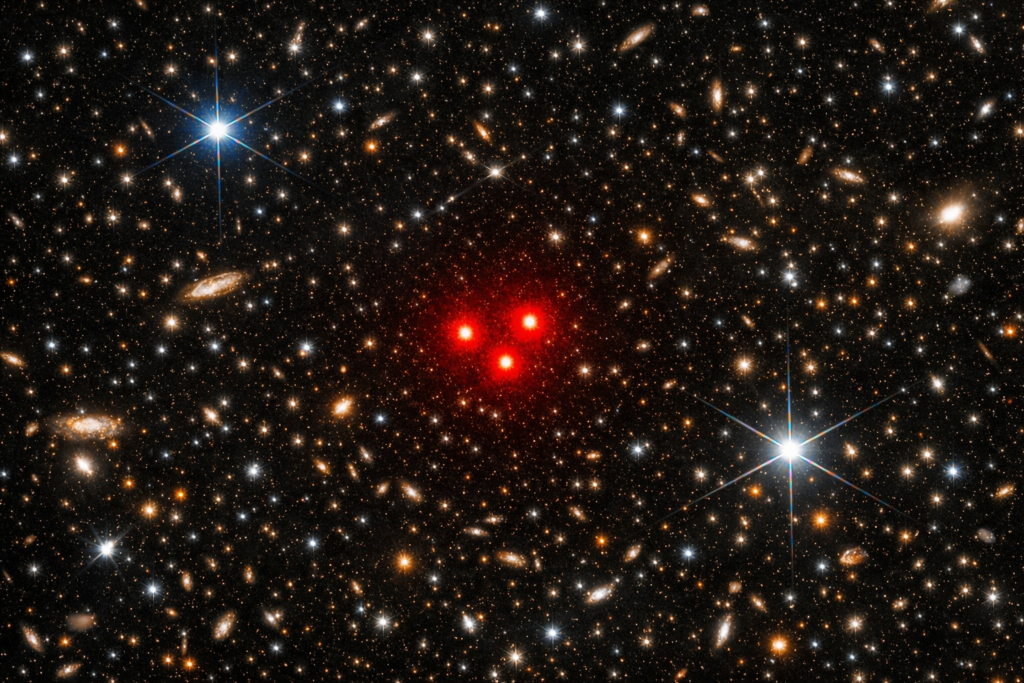
The Little Red Dots are extremely compact and luminous objects detected in the distant universe, which means we're watching them as they were billions of years ago, in their early stages.
Their peculiar reddish color and intense brightness have made them a focus of intense investigation.
Before Webb, telescopes like Hubble had already glimpsed these targets, but JWST's ability to observe at longer infrared wavelengths provided the necessary context to deepen our understanding.
The Previous Dominant Theory: Supermassive Black Holes in Formation
For a long time, explanations for the LRDs involved complex theories about black holes, accretion discs and dust clouds.
The most accepted hypothesis was that these points represented compact galaxies where supermassive black holes were growing rapidly, swallowing matter and emitting intense radiation.
This theory, although plausible, required specific and complex astrophysical scenarios to explain all the characteristics observed.
The New Revelation: Super Massive Monster Stars
A new survey, presented on January 6, 2026, at the 247th meeting of the American Astronomical Society in Phoenix, Arizona, proposes a surprisingly simpler and more elegant explanation.
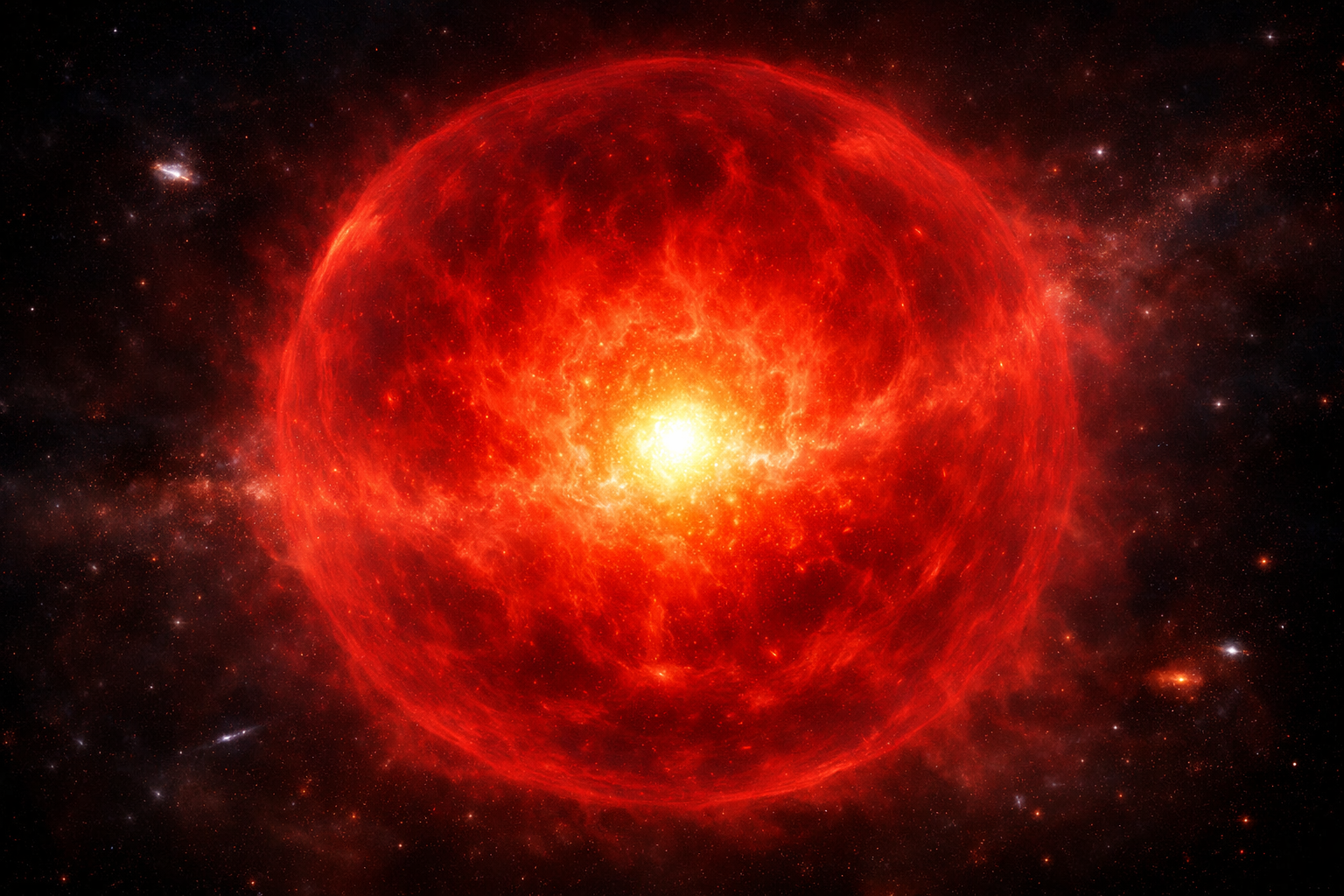
Astronomers of the CfA, led by Devesh Nandal, developed a detailed physical model that suggests that the LRDs are actually giant and short-lived supermassive stars [1].
These stars would be about a million times more massive than our Sun and would have a peculiar composition, being "metal-free" (heavier elements than hydrogen and helium).
The model shows that the unique features of these stars correspond perfectly to the signatures observed in the Little Red Points:
- Extreme Brightness: The enormous mass of these stars results in extraordinary luminosity.
- V-shaped Spectrum: A distinctive spectral signature that matches Webb's observations.
- Brilliant Hydrogen Emission: A rare feature that the model can reproduce.
But why "red"? The energy generated in the core of these stars spreads through an immense volume before reaching the surface.
This dramatically decreases the surface temperature of the star, giving it a distinct reddish appearance, despite its intense overall luminosity [1].
Implications for Cosmology: The Seeds of Black Holes
This discovery has profound implications for our understanding of the formation of the universe.
If the interpretation is correct, the Little Red Points are the final and bright moments that occur just before a giant star collapses into a black hole.
This means we are witnessing the birth of the "seeds" of supermassive black holes in real time [1].
Traditionally, the formation of supermassive black holes (those with millions or billions of solar masses found in the center of most galaxies) was a mystery.
The new theory suggests a direct path to its origin, providing a more solid basis for understanding how these cosmic giants and the galaxies that shelter them grew so rapidly in the early universe.
The Future of Research
Devesh Nandal and his team expect to find additional LRDs that are less luminous and massive. This would allow us to deepen the understanding of how and why these supermassive stars form and evolve.
James Webb will remain a crucial tool in this quest, opening new windows to the oldest secrets of the cosmos.
Conclusion: A New It was in Astrophysics.
The Little Red Points, before a riddle, now seem to be a key piece in the puzzle of universe formation.
The supermassive star theory not only explains its observed features, but also offers an unprecedented view of the origin of supermassive black holes.
Thanks to James Webb and the dedication of scientists, we are closer to unraveling the mysteries of cosmic dawn, rewriting our understanding of the history of the universe.
References
[1] Center for Astrophysics | Harvard & Smithsonian. "Scientists Use JWST to Examine Ancient Monster Stars That May Reveal the Birth of Black Holes". News. Available in: https://www.cfa.harvard.edu/news/scientists-use-jwst-examine-ancient-monster-stars-may-reveal-birth-black-holes. Access: 11 Jan. 2026.
[2] BBC News Brazil. "The mystery of the little red dots that intrigues scientists." Article. Available in: https://www.bbc.com/Portuguese/articles/c4g5zkqgk9go. Access: 11 Jan. 2026.