
Looking forward to the Severance Season 3: What the science fiction teaches us about memory and identity promises to further deepen the existential dilemmas that the Apple TV+ series has been exploring. In 2026, the dystopic narrative about a company that surgically separates the memories of its employees between professional and personal life is not just a work of television art; it is a catalyst for urgent debates about the nature of consciousness and the limits of neuroscience.
Here at TecNerds, we dive into the unique angle of how the premise of Severance connects directly with the latest research of 2026 on the selective erasure of memories, drawing a parallel between fiction and current science that few dare to explore in depth.
Severance Distopic Premise and Consciousness Fracture
No universe of SeveranceLumon Industries offers a revolutionary procedure: the "severance" (separation). This surgery divides the mind of an individual into two distinct personas – the "innie" (internal), which exists only in the working environment, and the "outie" (external), which lives the rest of life without any memory of what happens in Lumon. This division creates a fracture of consciousness, raising deep questions about the unity of the self.
The series, created by Dan Erickson and directed by Ben Stiller, shines in exploring the psychological and ethical ramifications of this technology, making us question: are we the sum of our memories? What if some of them were permanently inaccessible?
The Innie and the Outie: A Real-Time Mental Experiment
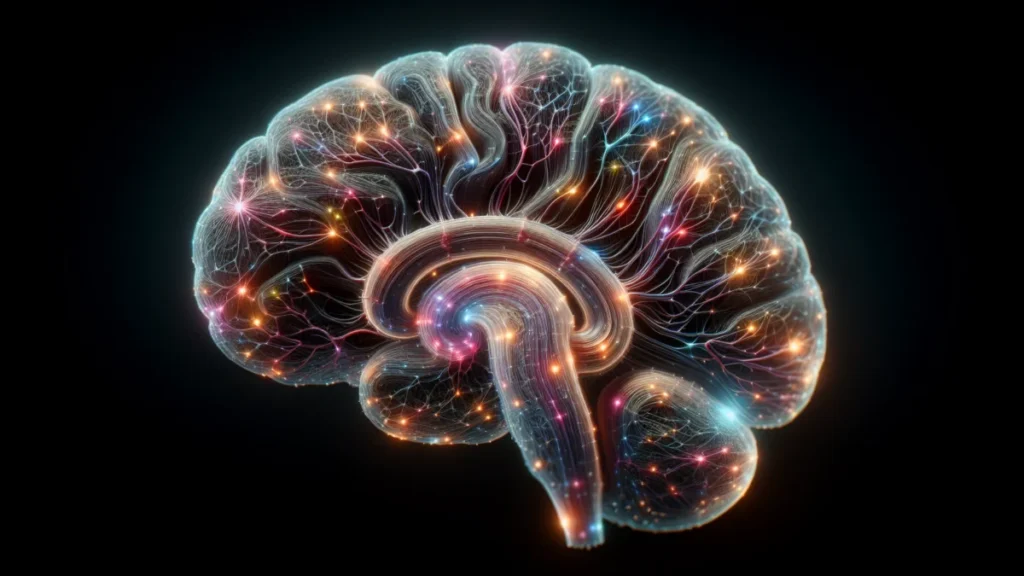
Generation by DALL-E 3 / OpenAI
The central characters, such as Mark S., Helly R. and Dylan G., experience this duality in a palpable way. Their innies are prisoners of a bizarre office, while their outies lead normal lives, alien to the suffering and discoveries of their counterparts. This dichotomy is the core of the series' teaching on identity.
Psychological Impact and Dual Existence
The experience of the Innies is of pure labor existence, without purpose or connection to an outside world. This generates anguish, search for meaning and even revolt, as seen in Helly R.'s determination to escape. For "outies", life is uncomplicated by the absence of work memories, but at the cost of a part of its own agency and consciousness. This paradox is a mirror to the complexity of the human psyche and how experiences, even if forgotten, can shape existence.
Selective Memory in the Series: Pure Fiction?
The memory separation in Severance Looks like something from science fiction filmBut how far away is she from the reality of 2026? The series not only entertains, but projects a scenario that, although exaggerated, dialogues with real advances in neuroscience. The idea that we can manipulate memories accurately is no longer something exclusively of the realm of imagination.
Neuroscience in 2026: Selective Memory Deletion
In 2026, the idea of selectively erasing memories, although still wrapped in ethical and technical complexities, is no longer a mere science fiction plot. Researchers around the world are deepening studies on the reconsolidation of memory – a process by which memories, once consolidated, become again labile when remembered, and may be modified or weakened before they are consolidated.
Studies indicate that interventions in this period of lability may have the potential to mitigate traumatic memories. The main objective of these studies is to treat conditions such as Posttraumatic Stress Disorder (PTSD) and severe phobias, not the creation of "innies" and "outies".
Current Techniques and Future Perspectives
The developing techniques include pharmacological and neuromodulatory approaches. Pharmacologically, the use of beta-blockers, for example, has been investigated in experimental contexts to reduce the emotional intensity of traumatic memories. In the field of neuromodulation, methods such as deep brain stimulation (DBS) and optogenetics (in animal models) are revealing complex mechanisms by which memories can be strengthened, weakened or even manipulated in specific neural circuits.
The focus, according to research on neuroplasticity and memory published in scientific journals, it is in the modulation of memory, not in its total obliteration, which marks a crucial distinction in relation to what we see in the literature. SeveranceBut it brings the fiction closer to scientific plausibility.
The Ethics of Memory Modification: Where the Fiction Find Reality
The largest contribution of Severance Perhaps it is your ability to force us to confront the ethical implications of such technology. If we could erase unwanted memories, what would be the consequences for our identity and humanity? Who would have the right to decide which memories are expendable? The series, with its representation of a corporation with power over the minds of its employees, serves as a warning tale.
"The National Research Ethics Council (CONEP) of Brazil, in 2026, continues to underline the ethical complexity of any intervention that fundamentally alters human cognition, especially memory, since it shapes our identity and learning ability, and has profound implications for individual autonomy and social justice." – Source: National Research Ethics Council, Brazil
Fiction alerts us to the danger of companies or governments that can exploit this technology for control or to suppress experiences that, though painful, are essential to the growth and formation of character. Ethical debate is central to how the society of 2026 will address these neuroscientific advances.
The main ethical questions raised by memory manipulation include:
- Who decides which memories are "desirable" and deserve to be erased?
- What are the long-term consequences for personality formation and psychological integrity of the individual?
- Could such technology be used for social, political or corporate control?
- What is the limit between a legitimate therapeutic intervention and a coercive or nonconsensual change of mind?
- Does changing traumatic memories hinder the learning needed to avoid similar future experiences?
Beyond the Series: Experiences Real with Trauma and Memory
In the real world, the question of memory and trauma is approached with great sensitivity. Therapies such as Cognitive-Behavioral Therapy (CTC) and Desensitization and Reprocessing by Eye Movements (EMDR) seek to help individuals process and integrate traumatic memories, not erase them. The goal is to reduce the negative impact of memory, allowing the person to reconstruct his narrative without losing a part of his story.
The World Health Organization (WHO) emphasizes the importance of holistic and ethical approaches to mental health and trauma, recognizing that memory is a crucial component of identity and well-being. For more information on mental health and trauma, WHO resources are invaluable.
Severance Season 3: Final Reflections and the Future of Identity
A Severance Season 3, by continuing the saga of his divided characters, invites us to a deep insight. It forces us to consider not only what defines our identity, but also what it means to be human in a world where technology promises to alter the very essence of our existence. In 2026, as science advances in broad steps in the field of neuroscience, the fiction of Severance serves as a moral compass, guiding our debate on the future of memory and identity.
FAQ on Severance Season 3 and Neuroscience
Is memory separation in Severance scientifically possible in 2026?
In 2026, the complete and surgical separation of memory as depicted in Severance It's not scientifically possible. However, studies on the modulation and selective weakening of traumatic memories, through pharmacology or neuromodulation, are ongoing and show promising advances, although with very different objectives and scopes.
What are "innie" and "outie" on the show?
"Innie" is the persona of the employee who exists exclusively within the company Lumon, without memories of his external life. "Outie" is the persona who lives outside of work, without any memory of her activities or experiences within Lumon. They are two distinct consciousnesses inhabiting the same body.
How does the series connect with real research on trauma and memory?
The series raises ethical and philosophical questions similar to what actual research on trauma and memory faces. While fiction seeks radical separation, science seeks ways to mitigate the suffering associated with traumatic memories without erasing personal history, respecting the integrity of identity.
What's Severance's main message about identity?
The main message from Severance is that identity is intrinsically linked to the totality of our experiences and memories. The series questions whether it is possible to be truly autonomous and complete when parts of our consciousness are isolated or denied, and warns about the dangers of corporate exploitation and fragmentation of being.
Do not miss the Severance Season 3 and continue to reflect on the impact of technology on our psyche. What is your opinion on the ethics of memory manipulation? Leave your comment below or share this TecNerds article with friends and colleagues to start a fascinating debate.