A IA Generative is killing originality in science fiction? The debate that is sharing fans in 2026 is one of the most effervescent topics in the circles of pop culture and technology.
With the exponential advancement of artificial intelligence tools, capable of producing texts, images and even complex scripts, the line between human creation and machine-assisted has become tenuous.
At TecNerds, we dive into this polarized discussion, analyzing the real impact of AI on science fiction, with examples of works launched in 2026 and the perspective of experts.
Since the beginning of 2026, the generational AI tools, such as advanced versions of ChatGPT, Midjourney and Stable Diffusion, are not only auxiliary tools, but also collaborators or even "authors" in several projects. This technological revolution raises deep questions about authorship, creativity and, above all, originality.
The Fascination and Fear of AI Generating in Creation
Generating AI's promise is seductive: democratizing creation, accelerating processes, exploring endless possibilities. For many, it is the next great frontier for science fiction, allowing independent creators with few resources to produce high-quality content or that large studios optimize the pre-production phase.
However, this promise is accompanied by a tangible fear. By delegating parts of the creative process to AI, are we not giving up that human spark, unpredictable and intrinsic to true originality? Fear is that science fiction, a genre known for its ability to innovate and question, becomes saturated with derivative narratives, generated from patterns existing in the vast training databases of AI.
The "Yes" Side: Efficiency, Accessibility and New Opportunities
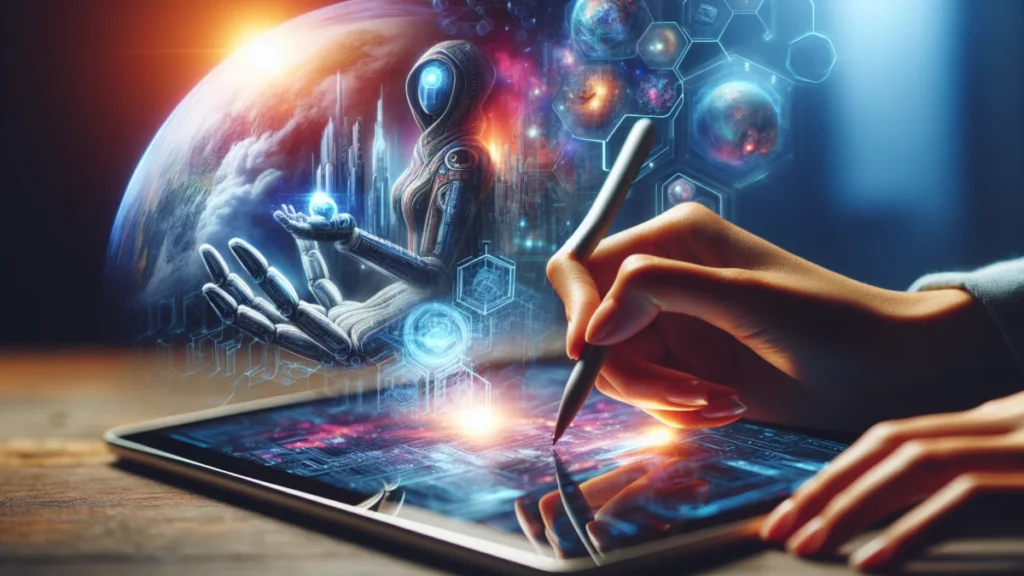
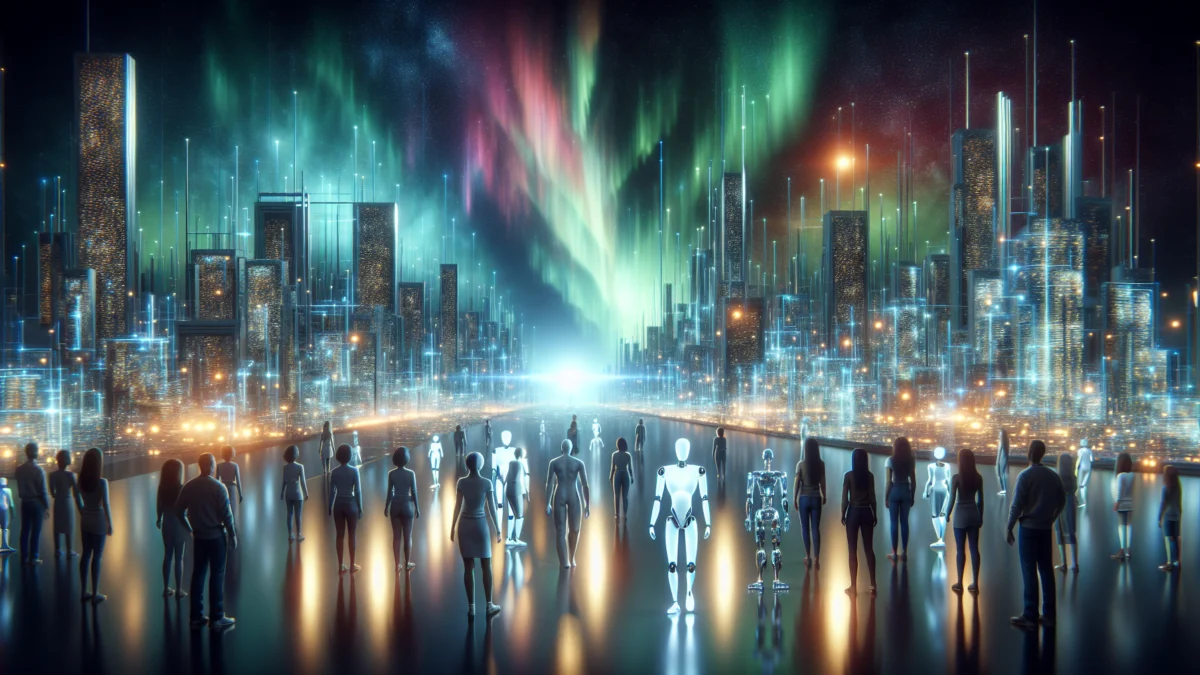
Generation by DALL-E 3 / OpenAI
Defenders of the use of AI in science fiction argue that technology is a tool, not a substitute. It can be used to overcome creative blockage, generate ideas for scenarios, characters or complex narrative arcs, or even visually prototyp entire worlds in a matter of seconds. For small independent studios or authors, AI significantly reduces production cost and time, making science fiction more accessible and diversified.
Practical example: The independent success of 2026, the digital book series "Echoes of Solaris", which quickly gained an adaptation for streaming, had its conceptual art, creature design and even improved dialogues made with the aid of AI such as "VisualForge 5.0" and "ScriptSense AI". The author, Elara Vance, said in an interview with TecNerds: "Without the AI, I could never have visualized my universe with such wealth and speed, which allowed me to focus more on the emotional depth of the characters."
Boosting Production and Experimentation
In addition to efficiency, the generative AI allows narrative experiments that would be unviable for humans due to time and effort. Imagine testing hundreds of variations of a final or a plot twist to see which generates the most impact? The AI can do that. The ability to quickly generate prototypes and "first drafts" can free creators to concentrate on the deepest layers of meaning and originality that only the human mind can offer.
The "No" side: The Crisis of Originality and the Creative Soul
To the other side of the debate, the concern is that the AI, when trained in existing data, tends to reproduce and recombine rather than genuinely innovate. True originality, they argue, is born from human experience, idiosyncrasies, errors and correctness that a machine, however advanced, cannot replicate. The result would be a homogenization of narratives, a generic "taste" in science fiction productions, where everything seems too familiar.
The renowned science fiction critic, Dr. Arthur C. Lowell, of the University of Brasilia, shared in a recent article: "The indiscriminate use of AI in creation not only dilutes authorship, but can also lead to a gradual decline in the search for truly new ideas. Ease can become a trap, replacing creative effort with efficient replication." (Source: Article of the University of Brasília, 2026).
The Challenge of Genuine Innovation
Science fiction has always been a fertile ground for the subversion of tropes and the exploitation of radically new concepts. The fear is that the AI, by optimizing the "revenue of success" based on past data, inhibits this capacity for rupture. Human creativity often flourishes in imperfection, in the unexpected, in what challenges logic and existing patterns, something that the large language models (LLMs) still struggle to replicate consistently and surprisingly.
Real Examples in 2026: Fiction with and without AI
The year 2026 has already offered us a clear sample of both sides of this coin:
- Works assisted by AI:
- "The Last Simulation" (Film, 2026): Praised for the stunning visual production, almost photo-realistic, generated largely by rendering and design AI. The script, however, which also had phases of "optimisation" by AI, was criticized for having a predictable plot and archetypal characters that seemed "too familiar" to the most demanding fans.
- "Metaverse of Desolation" (Game, 2026): An open-world RPG where the procedural generation of NPC missions and dialogues was largely powered by AI. It offers a vast experience, but some players reported the lack of a strong "authoral hand", resulting in narrative arches that, although unique in their combination, lacked a coherent and impacting emotional arc.
- Created Works Humanly:
- "Chronicles of Cerberus" (Romance, 2026): Written entirely by a human author, this science fiction novel won this year's Nebula Award for its poetic prose, development of complex characters and an ending that challenged all expectations, leaving readers thinking for weeks. Its originality resided in the way it subverted the clichés of the genus.
- "The Fall of Xylos" (Curta-film, 2026): An independent production that prioritized narrative and handmade visual experimentation. Despite a limited budget, the creativity of the human team in telling an exciting story with practical effects and an authorial script made it a darling festival, proving that the human soul still resonates deeply.
The Future of Science Fiction: Collaboration or Replacement?
The discussion is not binary. Many see the future as a model of collaboration, where AI acts as a powerful tool in the hands of human creators. The debate on the ethics of AI in creation is crucial in 2026, with growing discussions on attribution of authorship, fair remuneration for artists whose works train AI and the need for clear guidelines for responsible use.
In a recent UNESCO report of January 2026, it was highlighted that "the growth of AI-assisted content production has increased 300% in the last decade in creative sectors, but the perception of originality and the emotional impact of the generated works are still points of debate among the public."
It is still early to predict the final result, but we will probably see a segmentation: works where human intervention is valued as a seal of originality and authenticity, and others where the efficiency and scale of the AI are the main attraction. The audience of 2026 will be the final referee, deciding which types of stories and creation methods resonate more.
Regulation and Ethics: The Role of Industry in 2026
The science fiction industry, as well as other creative areas, is at a tipping point. There is a growing movement to establish clear ethical regulations and guidelines for the use of AI. Organizations of writers and directors, in collaboration with government agencies, are working to define what constitutes human authorship, how to protect copyright from material used to train AI and how to ensure transparency for the public about the origin of the content. A discussion on the impact of technology on the creative labour market It's more relevant than ever.
FAQs (FAQ)
1. Can Generative AI really create original stories?
Generative AI can create amazing combinations of ideas and styles, producing results that may seem original. However, its "originality" derives from the recombination of existing data. Human originality often involves completely new concepts that challenge patterns, something that AI, by its nature, has difficulty doing without a targeted human prompt.
2. How to identify if a science fiction work used AI?
Currently, it is a challenge, but certain characteristics can be indicative: a subtle inconsistency in style, visual elements that seem "generic" or a lack of emotional depth and thematic cohesion that only human intentionality can provide. However, with the evolution of the AI, the distinction will become increasingly difficult, and the transparency of the creators will be essential.
3. Will AI replace science fiction writers?
It is unlikely that the AI will completely replace the writers. Instead, it tends to become a powerful tool that increases writers' productivity and creative ability. The role of the writer can evolve into that of a "prompt architect" or curator, focusing on vision and emotion, while the AI takes care of more repetitive tasks or mass content generation.
4. What are the main risks of AI in originality?
Risks include market saturation with derivative content, dilution of the value of human creation, plagiarism or obscure copyright issues, and potential loss of distinct authorial voice. There is also the risk that the search for efficiency and volume obscures the search for genuine innovation and deep artistic meaning.
Conclusion: The debate continues in 2026
The debate about whether the Generative AI is killing originality in science fiction in 2026 is multifaceted and has no simple answer. It is a period of transition and redefinition for creativity. Technology offers unprecedented opportunities, but it also imposes ethical and philosophical challenges that require our attention.
Science fiction, by its very nature, has always reflected and explored the dilemmas of its time. Now she herself has become the battlefield of one of the greatest technological revolutions in history. It is up to us as creators, consumers and critics to shape the future of this genre, ensuring that innovation continues to flourish, whether it is driven by silicon, by soul, or by a harmonious combination of both.
What's your opinion on this? Do you believe the AI is a threat or an ally to originality in science fiction? Share your thoughts in the comments below!