
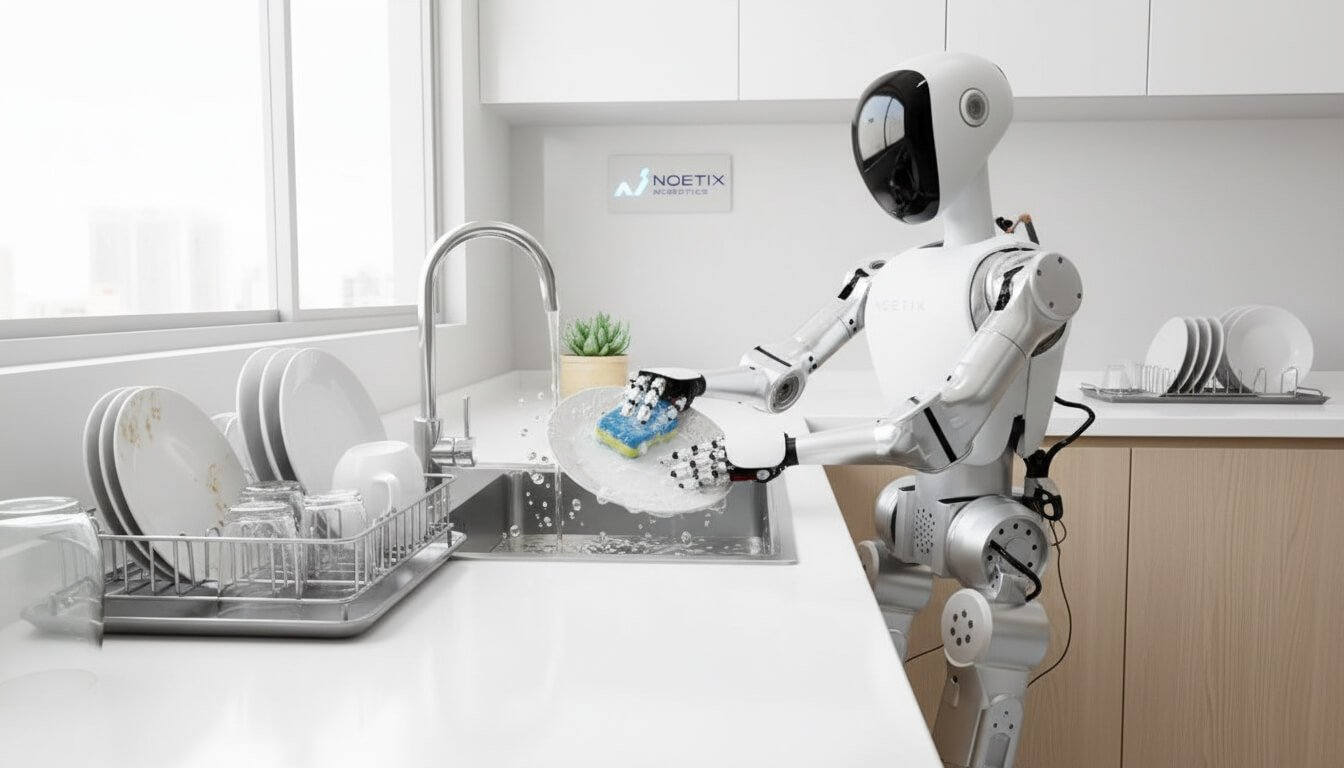
China is completely changing the game in the humanoid robot market. Two Chinese companies have just presented creations that promise to make this technology much more accessible and realistic than anything seen so far.
Bumi: The Cheapest Humanoid Robot in the World
The Beijing-based Noetix Robotics startup created something revolutionary: the Bumi, a humanoid robot that costs only R$ 7,369. This price represents a paradigm break in the sector, where similar robots cost tens or hundreds of thousands of reals.
At 94 centimeters high and weighing only 12 kilos, Bumi was developed specifically for educational and household use. Despite its compact size, his abilities impress: he can walk, maintain balance and even dance with remarkable stability for his price category.
The secret behind this reduced cost is intelligent engineering. Noetix used light materials, adopted a modular design and implemented a simplified control system that prioritizes functionality without compromising quality.
Technical Characteristics of Bumi
- Block programming: Intuitive system that facilitates learning
- Voice commands: Works as a personal assistant
- 48V battery: Autonomy up to two hours
- Educational tool: Ideal for schools and universities
- Domestic interaction: Designed to live with families
The company plans to launch the Bumi during festivals Double 11 and Double 12, taking advantage of China's high shopping season to boost sales.
Elf V1: Realism That Challenges Limits
While Noetix focuses on accessibility, AheadForm Technology has chosen a different path: creating the most realistic humanoid robot ever developed. The result is Elf V1, a creation that borders on science fiction.
This robot has characteristics that make it almost indistinguishable from a real human being. Its bionic skin, natural eye movements and precise facial expressions create a unique interaction experience in the market.
Advanced Elf V1 Technology
Elf V1 incorporates 30 facial muscles excited by brushless micro-engines, all controlled by a high precision system. This technology allows the robot to produce facial expressions almost identical to human expressions.
Resources include:
- Emotion detection: Low latency for real-time response
- Mobile eyes: Natural and convincing movement
- Synchronized speech: Perfect coordination between lip movements and voice
- Sign interpretation: Includes non-verbal signals
- Silent engines: Almost imperceptible operation
Last Generation Artificial Intelligence
The Elf V1 integrates Large-Scale Language Models (LLMs) and Language and Vision Models (VLMs), technologies that dramatically increase your ability to process complex human interactions.
This technological combination allows the robot to learn and adapt in real time, continuously improving their responses and behaviors based on user interactions.
AheadForm Technology: Purpose Innovation
Founded in 2024 by Hu Yuhang, PhD at Columbia University and expert in multimodal artificial intelligence, AheadForm represents the accelerated growth of the Chinese technology sector.
The company had previously launched the Lan series, focused on robots with efficient mobility and manipulation. The Elf V1 represents a natural evolution of this line, prioritizing expressiveness and emotional interaction.
Overcoming the Valley of Weirdness
One of the greatest challenges in the creation of humanoid robots is to avoid the "effect of the valley of strangeness" – a phenomenon that occurs when robots seem almost human but still generate discomfort in people.
AheadForm developed the Elf V1 specifically to overcome this barrier, creating a robot that feels natural and comfortable during prolonged interactions.
Market in Transformation
These inovações Chinese signal a radical change in the humanoid robot market. While Western companies focus on expensive industrial robots, Chinese startups are democratizing access to this technology.
The success of Noetix's previous model, the N2, which received more than 2,500 requests and participated in a half marathon of robots, demonstrates the growing demand for affordable and functional robots.
Practical and Potential Applications
Chinese humanoid robots open up possibilities in several areas:
Education
Robots like Bumi can revolutionize the teaching of programming, robotics and technology, offering a practical platform and accessible to students.
Domestic Assistance
With affordable prices, these robots can become real household assistants, helping with everyday tasks and offering company.
Health Care
The ability of the Elf V1 to interpret emotions and respond adequately makes it ideal for elderly care and assisted therapy.
Challenges and Considerations
Despite impressive advances, these robots still face limitations. Battery autonomy, durability of components and maintenance complexity are aspects that need continuous improvements.
Ethical questions about data privacy, security and human-machine relationship gain increasing importance as these robots become more realistic and accessible.
Perspectives for the Sector
The Chinese strategy of combining technological innovation with competitive prices can accelerate the global adoption of humanoid robots. Western companies will need to rethink their approaches to remain relevant in this rapidly evolving market.
O launch these robots mark a decisive moment in the history of robotics. For the first time, cutting-edge technology in humanoid robots becomes accessible to ordinary consumers, not just large corporations or research institutions.
The combination of Bumi's low prices with the extreme realism of Elf V1 demonstrates that China is determined to lead the next phase of the robotic revolution, making artificial companions a tangible reality for millions of people around the world.