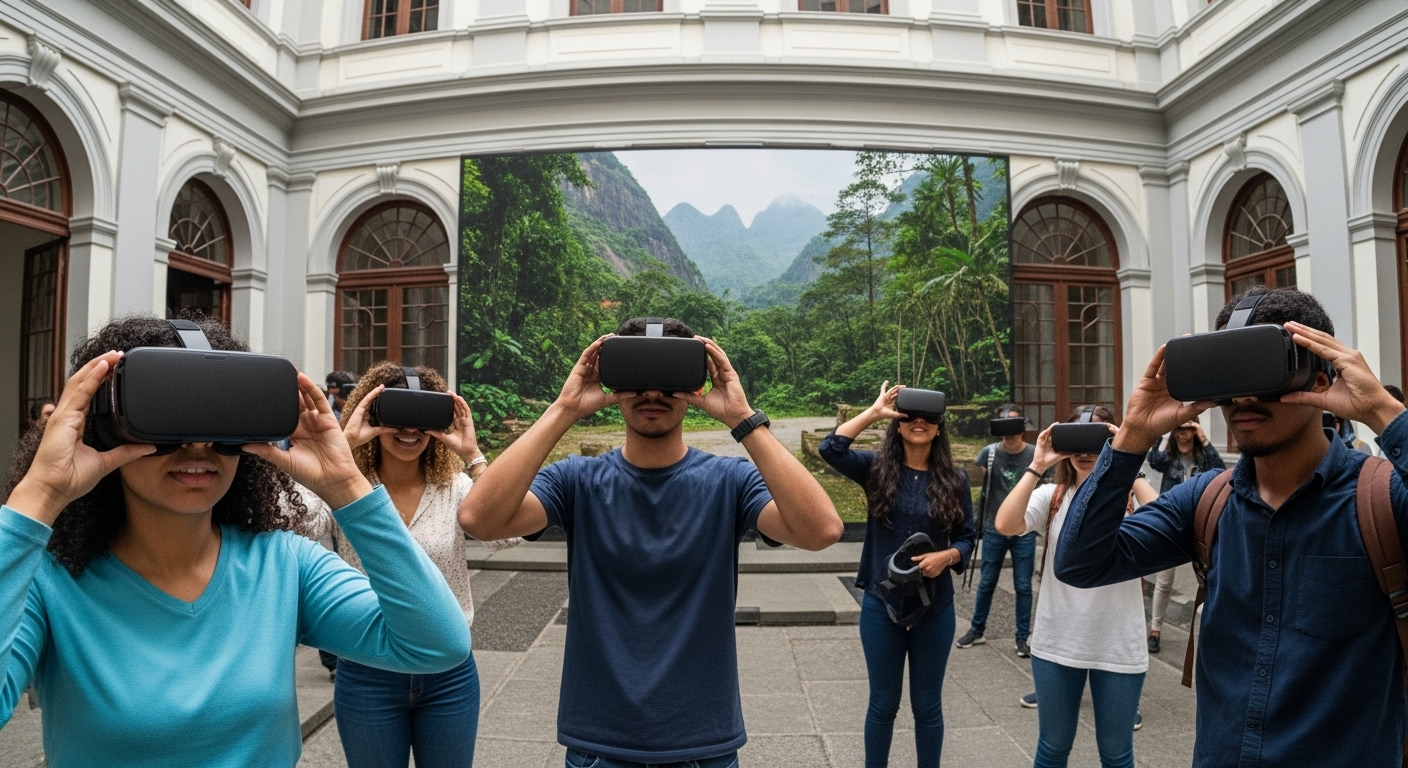
Higher education institutions invest in virtual environments to transform traditional learning methodologies
Brazilian higher education is experiencing a significant technological transformation with the growing adoption of virtual reality (VR) and augmented reality (RA) in their teaching methodologies. Technology emerges as a valuable complement to traditional methodologies, promoting a more inclusive education, according to recent research on immersive education.
Expansion of Immersive Technology in Higher Education
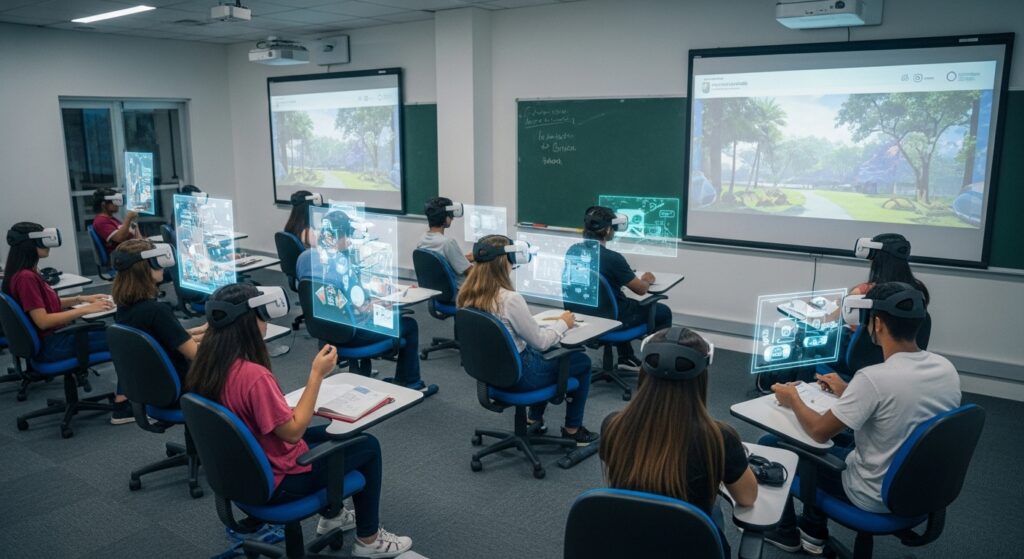
There are already higher education institutions that have a virtual campus identical to their physical facilities, with libraries, auditoriums, demonstrating the growing investment in educational virtual environments. This trend represents a fundamental change in how Brazilian universities address teaching and learning.
The integration of immersive technologies is not only limited to isolated experiments. There is a proliferation of research groups in Brazil focused on virtual reality in education, highlighting the growing academic interest in this area. Universities such as USP and UFRJ, recognized by their innovation technological, are at the forefront of this transformation.
Practical Applications of Virtual Reality
The RV allows students to explore immersive environments that simulate real or imaginary situations, facilitating practical and visual learning. History students can "visit" ancient civilizations, while science students can explore the interior of a cell.
This versatility of VR technology has allowed applications in various areas of knowledge:
Medicine and Biological Sciences: Students can perform virtual dissections, explore body systems in microscopic details and practice medical procedures in safe and controlled environments.
Engineering and Architecture: Future engineers can visualize complex structures, test projects in simulated environments and understand physical concepts through immersive experiences.
History and Archaeology: The possibility of "travel" in time allows students to experience historical events and explore archaeological sites in a unique and engaging way.
Benefits Proof of Immersive Education
RV provides an immersive learning experience, where students can feel that they really are within the content addressed. This fundamental characteristic of virtual reality has generated measurable positive results in the educational process.
Increased Reality and Virtual Reality encourage creativity, allowing students to explore and create virtual environments. These technologies make education more inclusive, allowing students with disabilities to have learning experiences similar to their peers.
O active learning it becomes a tangible reality when students can interact directly with the content, manipulate virtual objects and experiment abstract concepts in a practical and visual way.
Challenges of Implementation
Despite the obvious benefits, the implementation of virtual reality in education still faces significant obstacles. It is notably greater complexity in designing and using them than conventional software, where the user is often used to technologies.
The main challenges include:
Implementation Cost: Educational quality RV equipment still represents a considerable investment for public institutions, which already face budgetary limitations.
Teacher Training: Teachers need specific training to effectively integrate these technologies into their teaching methodologies.
Infrastructure Technological: Implementation requires significant upgrades in the IT infrastructure of universities, including high-speed connections and specialized equipment.
Current Scenario of Brazilian Universities
UFRJ is the second most innovative university in Brazil, while USP has a budget of R$ 1.19 billion in 2024, demonstrating the disparity of resources among the main Brazilian institutions. This budgetary difference directly impacts the investment capacity in advanced educational technologies.
UFRJ occupies the 4th general place among the best universities in Brazil according to the Leaf University Ranking (RUF) of 2024, consolidating its position as one of the country's leading research and innovation institutions.
Implementation Guidelines Effective
Researchers have proposed guidelines to foster student engagement in virtual reality environments, highlighting the need for structured approaches to maximize the benefits of this technology.
Educational environment designers with AR need guidelines to make these systems more usable and thus reduce the learner's cognitive load.
Future perspectives
The future of Brazilian education seems increasingly connected with immersive technologies. The teacher remains the mediator of the learning process, and it is up to him to select and adapt the technologies to the specific needs of his students.
A trend indicates that in the coming years, virtual reality will become an educational tool as common as computer labs are today. The increasing investment in research and development in this area, combined with the gradual reduction of implementation costs, suggests a promising scenario for immersive education in Brazil.
Conclusion
Virtual reality in education represents more than a technological innovation; it is a pedagogical revolution that is redefining the possibilities of teaching and learning. Although there are still challenges to be overcome, the benefits shown and the growing interest of Brazilian institutions indicate that this technology has come to stay and definitely transform higher education in the country.
Sources: Contemporary Magazine, Revista Iberoamericana de Tecnología en Educación, Revista Sociedade Científica, Sophia, Pearson HED, ScanSource, Programae, POA24Horas, Ranking Universitário Folha 2024