
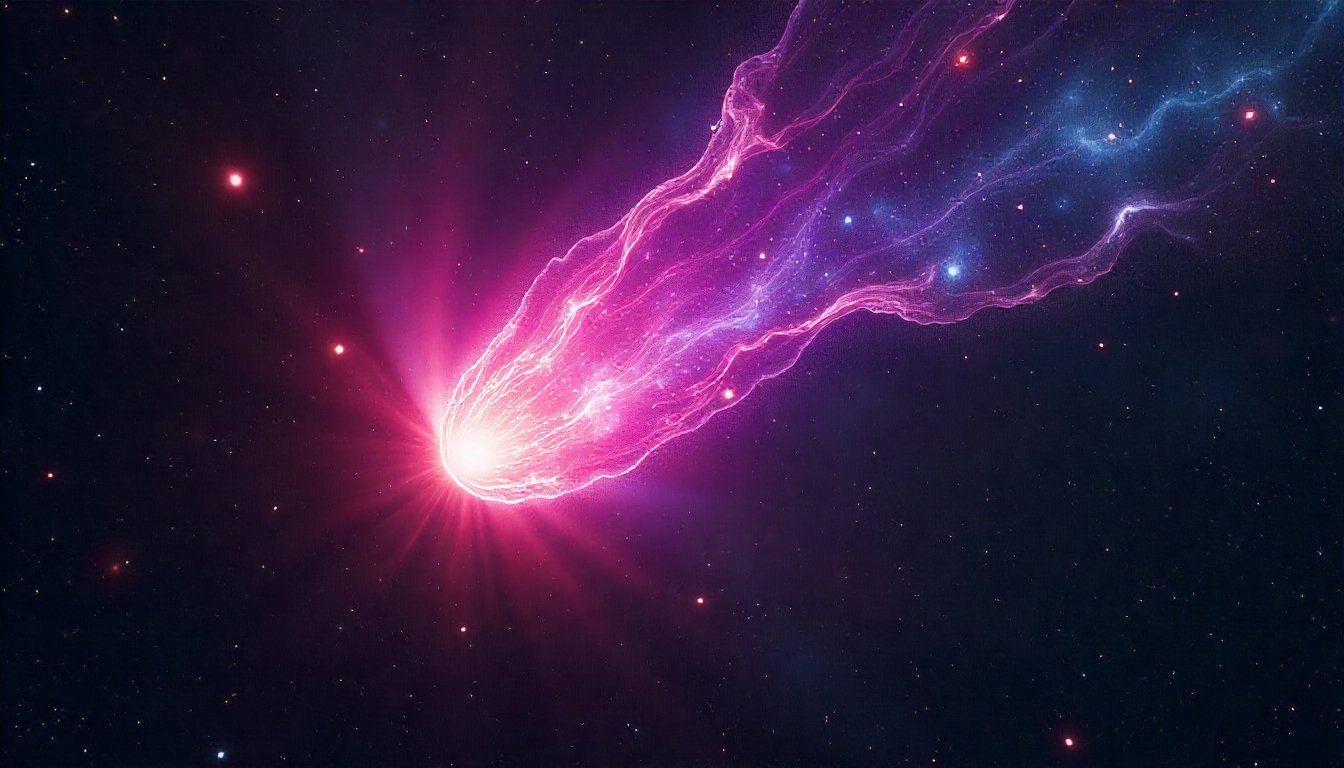
In a discovery that marks a new chapter in modern astronomy, the interstellar comet 3I/ATLAS is providing scientists with a unique opportunity to study an object formed in another solar system.
Discovered in July 2025, this cosmic visitor represents only the third confirmed interstellar object to cross our Solar System, offering unprecedented insights into planetary formation in distant regions of the galaxy.
What Makes Comet 3I/ATLAS Special
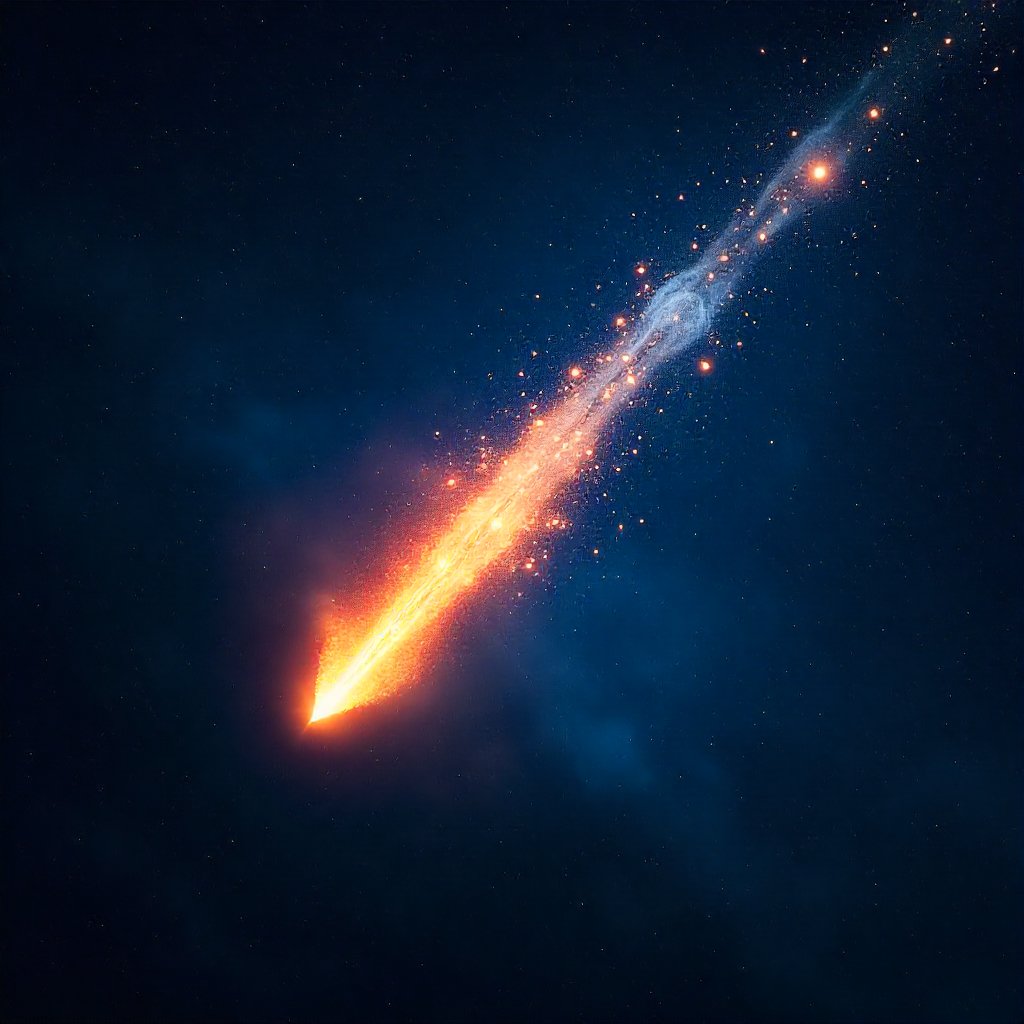
The comet 3I/ATLAS It's not just another celestial body passing through our Solar System. Yours hyperbolic trajectory and unique composition distinguish it from any object already observed, making it a natural laboratory for the study of star formation processes in completely different environments of ours.
Extraordinary Physical Characteristics
Initial observations revealed fascinating features of 3I/ATLAS:
- Dimensions: Estimated core between 500 meters and 5 kilometers in diameter
- Speed: Approximately 200,000 km/h through space
- Unusual composition: High concentration of carbon dioxide compared to water
- Single optical behavior: Patterns of light reflection never before observed
Revealing Chemical Composition
Spectroscopic analysis of the 3I/ATLAS revealed a chemical composition that challenges our understanding of comets. While comets typical of the Solar System have a predominance of frozen water, this visitor interstellar displays:
- High concentrations of CO2 (carbon dioxide)
- Low water vapour levels compared to expected
- Presence of unidentified complex organic compounds
- Silicate minerals with distinct isotopic signatures
Historical Approach to Mars
On October 3, 2025, comet 3I/ATLAS starred in an unprecedented astronomical event as it became only 29 million kilometers from Mars. This approach offered a privileged observation window that will not be repeated for decades.
Mobilized Observation Instruments
The international scientific community has coordinated a massive observational campaign involving:
- Marcian Probes: Mars Express, ExoMars Trace Gas Orbiter, and rovers on the surface
- Space telescopes: Hubble, James Webb, and infrared observatories
- Land Networks: Very Large Telescope (VLT), ESO observatories
- Radio telescopes: To detect specific molecular emissions
Collected Data During Approach
Observations during the passage near Mars provided:
- High resolution images: Details never before seen from nuclear structure
- Coma analysis: Three-dimensional cloud mapping of gases and dust
- Speed measurements: Precise confirmation of hyperbolic trajectory
- Advanced spectroscopy: Identification of specific chemical compounds
Origin and Training in Distant Star Systems
Analysis of the trajectory and composition of the 3I/ATLAS provides crucial clues about its origin. Scientists believe the comet was formed in a young star system, possibly in a region of active star formation located hundreds of light-years away.
Inferred Training Conditions
Based on the characteristics observed, researchers infer that 3I/ATLAS formed under specific environmental conditions:
- Extremely low temperatures: Colder regions than those found in our outer Solar System
- Intense stellar radiation: Environment rich in ultraviolet radiation and X-rays
- Abundance of CO2: Molecular clouds rich in frozen carbon dioxide
- Radiation processes: Chemical alteration caused by prolonged cosmic radiation
Scientific and Discovery Implications
The study of comet 3I/ATLAS is revolutionizing our understanding of the formation of planetary systems and the distribution of organic materials in the galaxy.
Planetary Formation Insights
The findings related to 3I/ATLAS have profound implications for our understanding of:
- Chemical diversity: Different stellar environments produce unique compositions
- Transport of materials: How organic compounds are distributed throughout the galaxy
- Primary conditions: Training environments in young star systems
- Chemical evolution: Processes that change composition over time
Comparison with Visitors Prev
O 3I/ATLAS is the third interstellar object confirmed by:
- 1I/’Oumuamua (2017): First interstellar object, elongated and unusual shape
- 2I/Borisov (2019): First confirmed interstellar comet, more familiar composition
- 3I/ATLAS (2025): More exotic chemical composition and unique behavior
Future Trajectory and Observation Opportunities
After the encounter with Mars, comet 3I/ATLAS will continue its epic journey through the Solar System, offering multiple opportunities for observation.
Events Schedule
- October 2025: Approaching the Sun (perihelion), intensification of cometary activity
- December 2025: Earth's closest approach (270 million km)
- Start of 2026: Pass near Jupiter, gravitational studies
- Medium 2026: Final exit of the Solar System towards interstellar space
Future Missions Proposals
The rarity of the event prompted proposals for rapid intercept missions:
- High-speed probes: Concepts to reach the comet before its departure
- Dedicated Observatorys: Telescopes specialized in long-term tracking
- Collaborative networks: International coordination to maximize collected data
Impact on Astrobiology and Search for Life
Comet 3I/ATLAS carries significant implications for astrobiology, especially with regard to the transport of complex organic compounds between stellar systems.
Identified Organic Compounds
Spectroscopic analyses revealed the presence of:
- Complex organic molecules not previously identified
- Possible amino acid precursors
- Carbon compounds in various oxidation states
- Crystal structures that can preserve organic materials
Conclusion: A Window to Cosmos

The interstellar comet 3I/ATLAS represents more than just an extraordinary cosmic visitor – it is a galactic time capsule which gives us unique insights into the formation of distant worlds and the chemical processes that occur in other star systems.
The discoveries related to 3I/ATLAS are rewriting our understanding of the chemical diversity of the cosmos and demonstrating that each star system can produce unique signatures on its constituent objects.
As we continue to study this exceptional visitor, we expand not only our scientific knowledge, but also our perspective on the place of the Earth in the broader galactic context.
The passage of the 3I/ATLAS through our Solar System marks the beginning of a new era in interstellar astronomy, where each new visitor carries secrets about the origin, evolution and distribution of matter in the universe.
For astronomy scientists and enthusiasts, this comet represents a unique opportunity to witness firsthand the diversity and complexity of the cosmos around us.