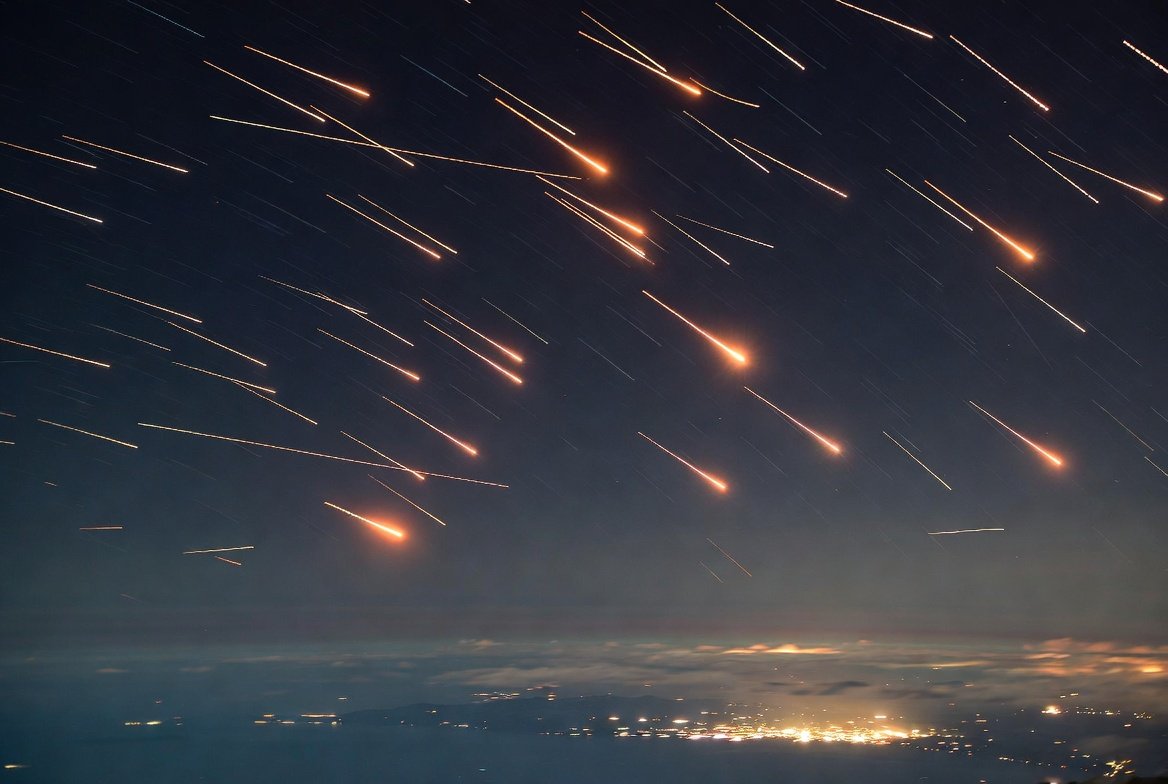
A meteor shower Geminides is in full activity and promises a real show in the Brazilian sky. The phenomenon began on Thursday (11) and continues until Tuesday (16), with the summit happening between Saturday night (13) and Sunday morning (14).
Considered the most intense of the year, the rain has already been recorded in Rio Grande do Sul. Eduardo Santiago, from Project Exoss coordinated by Dr. Marcelo de Cicco of the National Observatory, managed to capture the first meteors in Nova Santa Rita (Folha de S.Paulo).
How many meteors can you see per hour?
The National Observatory estimates that it will be possible to observe about 35 meteors per hour during the peak of the Geminídeas in Rio Grande do Sul. This projection considers ideal conditions: clear skies, low light pollution and absence of the Moon in the field of vision.
The estimate admits a margin of error of approximately 15%. The phenomenon is named for appearing to radiate from the constellation Gemini and is partially visible throughout the Brazilian territory (Earth).
Best time to watch
Professor Gabriel Hickel, Federal University of Itajubá (UNIFEI), recommends that the observation happens between 22h and dawn. However, it is necessary to be alert to the Moon, whose brightness can make it difficult to visualize the less luminous meteors.
The current lunar phase – in transition from dwindling to new – mainly impairs observation in the second half of the night. So the best times are:
- Nights of 11, 12 and 13 December: between 10:30 and midnight
- Nights of 14 and 15: from 10:20 p.m. to 2 p.m. (Time of Brasilia)
How to observe without equipment
No special equipment is required to accompany the Geminides. The main requirement is a clear sky, which can be challenging at this time of year in Brazil.
Experts indicate directing the look to the region of the Three Marias and using peripheral vision to increase the chances of sighting. There's no fixed point in the sky to observe.
Practical tips for a better experience
Choose a dark spot, far from urban lighting, with free horizon. Place yourself comfortably, as in a reclining chair, to have a wide view of the sky.
Avoid looking directly at the Moon as the brightness reduces visual adaptation. Be patient and wait about 15 minutes for your eyes to adapt to darkness.
Observe for at least an hour and keep realistic expectations – the phenomenon does not resemble a continuous spectacle of fireworks.
Why are the Geminides special?
About 30% of the Geminides meteors are bright, making them easier to observe than other meteor showers. The term in females is used because "falling stars" is the popular designation for meteors, according to the National Observatory.
Professor Hickel clarifies that "geminids" in male is equally correct, since both forms are accepted in the admiralization of Latin.
Weather conditions may interfere
The main challenge for observation in Brazil at this time is cloudy weather, characteristic of summer. Therefore, check your region's weather forecast before programming.
Regions with less light pollution, such as rural areas or parks away from urban centers, offer the best conditions to enjoy the celestial spectacle.
A meteor shower Geminides it represents a unique opportunity to connect with the cosmos, without the need for investments in expensive equipment or advanced technical knowledge.
Geminide Magic: A Single Cosmic Show
If you've ever been lucky enough to witness a Geminide meteor shower, you know it's an unforgettable experience. Unlike other meteor showers that originate from frozen comets, the Geminides are born from the asteroid 3200 Faeton – a peculiar rocky body orbiting the Sun.
What makes this phenomenon even more special is the intensity of meteors. While most rains produce between 20 and 40 meteors per hour, the Geminides can reach impressive 120 meteors per hour during the peak. It's like the sky is celebrating the end of the year with its own burning of natural fires!
Why do we call them Cadente Stars?
Despite the popular name, the meteors we see during the meteor shower Geminides are not stars. These are rock fragments and dust from the asteroid. Faeton entering our atmosphere at incredible speeds of about 35 km per second.
When these fragments collide with the air molecules in our atmosphere, intense friction generates extreme temperatures that vaporize the material, creating the luminous tracks we admire so much. It's pure physics transformed into visual poetry!
How to Photograph Geminides
If you're passionate about photography and want to capture the beauty of meteor shower Geminides, here are some practical tips:
Equipment Essential:
– DSLR or mirrorless camera with manual mode
– Wide angular lens (14mm to 24mm)
– Robust Tripod (fundamental!)
– Remote control or timer
Settings Recommended:
– ISO: 1600 to 3200
– Opening: f/2.8 or greater
– Exposure time: 15 to 25 seconds
– Focus: Manual in infinity
💡 Professional Tip: Take several consecutive photos for 1-2 hours. So you increase your chances of capturing multiple meteors and you can even create an awesome time-lapse!
Why Are Geminids Visible in Brazil?
One of the great advantages of meteor showers Geminídeas is its privileged visibility in the Southern Hemisphere, including the entire Brazilian territory. The constellation Twins, from where meteors appear to originate, is well positioned in the sky during the nights of December.
Cities like Rio de Janeiro, São Paulo, Brasília and Porto Alegre have excellent opportunities for observation, provided you escape from urban light pollution. State parks, rural areas and remote beaches are ideal locations.
Sources
- Folha de S.Paulo – https://www1.folha. uol.com.br/science/2025/12/how-to-see-the-meteoros-geminideas-with-peak-of-sabado-13-for-sunday-14. shtml
- Earth – https://www. land. with.br/noticias/meteor shower-geminida-peak-like-on this weekend,049aaaa06c6894f8ce9d03c614f19474csjvgdo2d.html