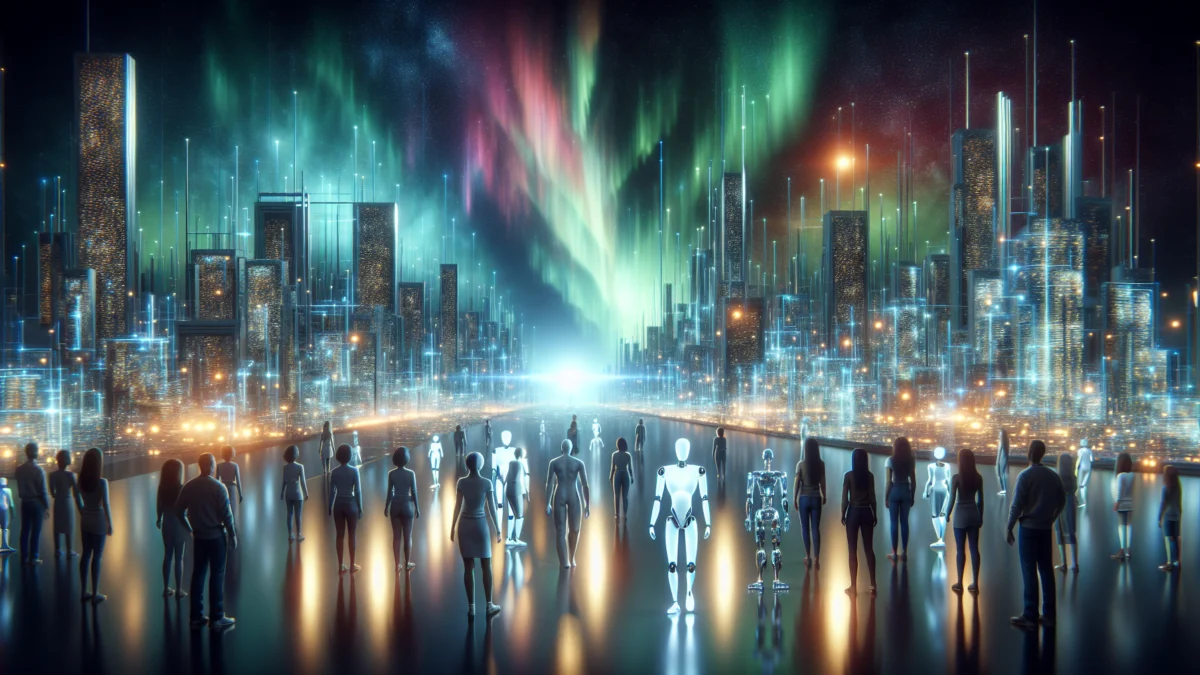

A artificial intelligence (IA) is one of the most debated topics in modern society. From its origins, more than half a century ago, to recent advances with tools like ChatGPT, the growth of AI has been exponential. In this post, we will explore the history of AI, its main milestones and the implications of its development. Let us answer the question: who created artificial intelligence and how it evolved over time?
The Roots of Artificial Intelligence
A History of Artificial Intelligence begins in 1943, when scientists began to explore the idea of replicating the structure of the human brain through neural networks. This initial research laid the foundation for what would become the modern AI.
Alan Turing and the Turing Test
In 1950, Alan Turing asked a fundamental question: "Can machines think?" Turing also developed the famous Turing Test, which is still used today. The test involves an interrogator who talks to two entities, a human and a machine. If the interrogator cannot distinguish between the two, the machine is considered intelligent.
Definition of Artificial Intelligence
In 1956, at the Dartmouth Conference, some of the founders of the AI defined the field as the ability of a machine to perform tasks that require human intelligence, such as learning, reasoning and solving problems. This definition remains a pillar of AI to this day.
The First Advances
After the definition of AI, several advances began to emerge quickly. In 1958, Frank Rosenblatt created Perceptron, the first model of artificial neural network, which, although rudimentary, already showed promising future directions.
Machine Learning and First Chatbot
In 1959, Arthur Samuel developed machine learning, teaching a computer to play ladies, and he won the state champion. In 1965, the first chatbot, called ELIZA, acted as a psychotherapist and asked questions to explore the minds of users.
The Winters of Artificial Intelligence
The AI went through periods of stagnation, known as "IA winters". The first major winter occurred in 1980 due to processing limitations and lack of practical results. However, some advances, such as character recognition through neural networks, continued to be developed.
Developments Important in the 1990s and 2000s
In 1997, IBM's Deep Blue defeated Garry Kasparov, a significant milestone for AI, although the system did not use neural networks but advanced search algorithms. In the years 2000, there was an explosion in machine learning and computational power, allowing the development of new techniques such as supervised, unsupervised learning and reinforcement.
The Growth of Artificial Intelligence
In 2012, AlexNet's victory in an image recognition competition was a water divider. AlexNet's convolutional neural network surpassed the others with a significantly smaller margin of error, demonstrating the effectiveness of deep learning techniques.
Complex Games and AlphaGo
In 2016, AlphaGo defeated Lee Sedol in the game of Go, a monumental challenge due to the complexity of the game. This proved that AI could learn and adapt to games with a multitude of possibilities, something that was not feasible only with search algorithms.
The Age of Transformers and ChatGPT
In 2017, the research "Attention is All You Need" introduced the architecture of Transformers, which revolutionized natural language processing. This technology led to the creation of ChatGPT, which allowed AI to become accessible to the general public, democratizing the use of advanced AI tools.
The Exponential Age and Your Challenges
We are now in the so-called "exponential age", where changes occur quickly. However, along with opportunities, concerns arise about the dangers of AI, such as mass unemployment and the creation of autonomous weapons. Pessimists warn about the risks of an AI out of control, but there are also many who see AI as a tool to solve complex problems such as diseases and renewable energy.
The Future of Artificial Intelligence
The future of AI is promising, but also uncertain. 90% of cognitive work is expected to be automated in the coming years, leaving only 10% for functions that require creativity and critical thinking. AI is not only a threat, but also an opportunity to improve human life and solve critical problems.
Estreita Artificial Intelligence and General
The AI we know today is called narrow artificial intelligence, which is designed to perform specific tasks. However, aspiration is to develop a general artificial intelligence that can perform a wide range of activities in a manner similar to humans. The next stage would be higher artificial intelligence, which would overcome human intelligence in many respects.
Final Considerations
With all these advances and challenges, the question "Who created artificial intelligence?" is answered not only by an individual, but by a community of scientists and thinkers over the decades. The AI is shaping the future so that it seemed impossible before, and its development should be closely accompanied to ensure that the benefits are maximized and the risks minimized.
A artificial intelligence is an essential part of our technological evolution And as we continue to explore their capabilities, we must always consider how we can use it for the good of humanity.