The scarcity of drinking water is a worrying reality in various parts of the world. Although our planet is largely covered by water, only a small fraction (2.5%) is sweet and accessible, with much frozen in glaciers or trapped in underground aquifers.
According to data from the World Health Organization, billions of people live without access to safe sources of drinking water, facing significant challenges for their health and livelihood.
However, a solution innovative arises from the study of technology to capture water from the air, exploring the vast reservoir of moisture present in the atmosphere.
Capturing Atmospheric Humidity: A Promising Technology
MIT researchers developed a Technology to capture air water in dry climates, able to extract drinking water directly from the atmosphere, even in desert regions.
This innovation uses a system based on a material called hydrogel, a polymer with high moisture absorption capacity.
This hydrogel for air water capture is strategically positioned between two glass plates, creating a device similar to a window that works as an efficient atmospheric water collector for desert regions.
The Operation of the Atmospheric Water Collector
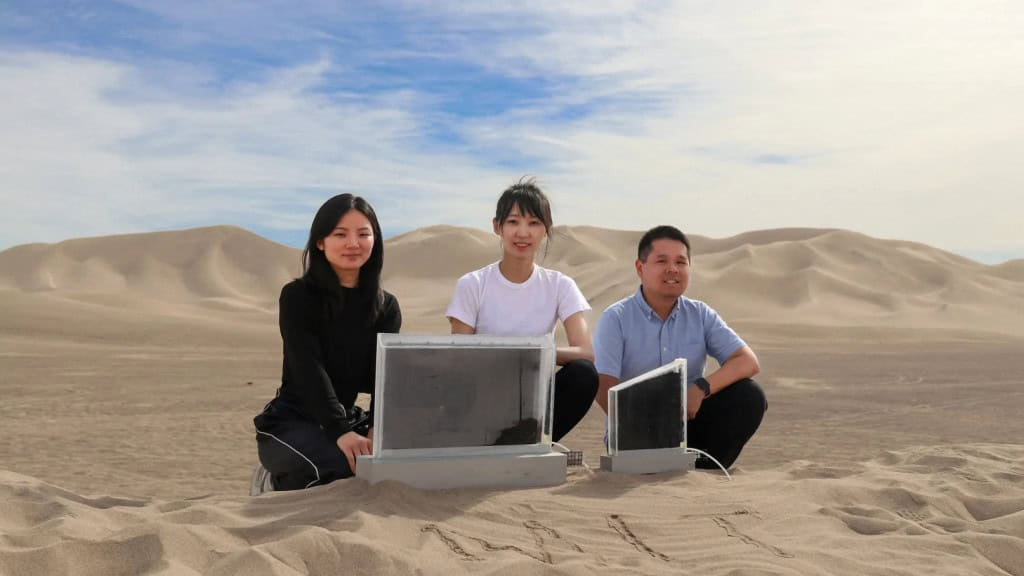
The process of how to collect water from the atmosphere in arid regions It's surprisingly simple and efficient. O hydrogel absorbs moisture present in the air.
As moisture is absorbed, the material expands and contracts, similar to an origami movement. During the day, water vapor condenses on glass surfaces.
At night, condensed water it drains through an exit tube, being collected in a reservoir. This sustainable atmospheric water capture system does not require external energy, eliminating the need for batteries or solar panels, making it ideal for remote areas with limited resources.
An Autonomous and Efficient System
One of the most remarkable aspects of this technology to capture air water It's your autonomy. Unlike other methods that depend on external energy sources, this system operates passively, taking advantage of the natural temperature variation between day and night to condense moisture.
Tests conducted in the Valley of Death, California – one of the most arid regions in the world – demonstrated the effectiveness of the system.
A prototype of half a square meter managed to extract up to 160 milliliters of drinking water per day, demonstrating its potential to provide drinking water in desert areas.
Overcoming Water Quality Challenges
To ensure the potability of the collected water, the researchers incorporated a salt stabilizer, glycerol, to the hydrogel. This minimizes the release of lithium salts, used to improve the absorption capacity of hydrogel, ensuring that the water collected meets the quality standards established by regulatory agencies such as the United States Geological Service.
This crucial detail guarantees the safety and system reliability as a source of drinking water.
Potential and Applications of the Atmospheric Water Collection
The research team believes that eight panels of 1 meter by 2 meters would be sufficient to meet the needs of a residence in regions without access to conventional sources of drinking water.
The estimated cost for the implementation of the system is comparable to the monthly cost of water bottled in the United States, becoming a viable and accessible alternative for needy communities.
Building a DIY Water Collector
Although the complexity of hydrogel requires laboratory production, the basic principle of Homemade atmospheric water collector can inspire low-cost projects, using alternative materials for moisture absorption.
Research in the development of more accessible materials for the construction of a DIY Air Water Collector It is essential to expand access to this technology.
The possibility of capture water from air humidity in rural areas or deserts represents a significant advance in the fight against the scarcity of water. This extraction of drinking water from air with plastic, while still developing, demonstrates the transforming potential of innovation technology in the search for sustainable solutions for one of the biggest global challenges: universal access to the drinking water.
A extraction of drinking water from air with plastic, in that case hydrogel, represents an innovative and promising approach to ensuring access to drinking water in arid regions.
The combination of efficient design, low cost and environmental sustainability makes this technology a strong candidate to revolutionize access to water all over the world.
The development of a Homemade atmospheric water collector Simplified, accessible and scalable, can be crucial to expanding the impact of this technology, leading to drinking water the communities they need most.
For more information on the research and development of this technology, visit the sources mentioned below.
Source: LOOK DIGITAL